

What You Need to Brew Loose Leaf Tea in a Teapot
Learning how to brew loose leaf tea in a teapot comes down to four things: good leaves, fresh water, the right temperature, and correct timing.
Here is why it matters. Loose leaf tea is whole or large-leaf tea, not the fine dust left over from processing.
The good news is that loose leaf brewing is not fussy. It rewards a little care, not perfect technique.
Choosing a Teapot That Suits How You Brew
Pick a teapot by size and material, not by looks alone. A 500ml to 600ml pot suits two to three cups. A smaller 250ml pot suits one person who wants a fresh brew each time.
Material changes how the tea tastes:
- Glass shows the leaves unfurling and holds no flavour between brews.
- Porcelain holds heat well and stays neutral.
- Cast iron keeps tea hot for longer, best for black tea.
If your pot has a built-in infuser basket, brewing is simple. If it does not, you will need a separate infuser or strainer. We cover both below.
Why Loose Leaf Beats Dust and Fannings
Whole leaves give you more control. Because they brew slowly, there is a wider window between "just right" and "too bitter". Dust brews in seconds and turns harsh fast.
You also get more than one cup from the same leaves. Whole leaves hold their structure, so a second or third steep still tastes like tea rather than water. That is the practical case for loose leaf, and it is a strong one.
How Much Loose Leaf Tea Per Cup (and Per Teapot)
The standard measure is one teaspoon of loose leaf tea per cup, plus one extra teaspoon for the pot. For a 600ml pot holding three cups, that means four teaspoons of leaves. The extra spoonful is not a tradition, it compensates for the leaf-to-water contact being less efficient in a larger body of water, where leaves sit deeper and circulate less than they would in a single cup.
Weight is more accurate than volume, because leaf size varies enormously. A teaspoon of fine Darjeeling and a teaspoon of long, wiry OP1 are nowhere near the same mass. As a guide:
- Large leaf tea such as OP1: about 2 grams per cup
- Broken leaf tea: about 1.5 grams per cup
- Fine or rolled leaf tea: about 1 gram per cup
A kitchen scale removes the guesswork. If you do not have one, use a teaspoon and adjust to taste.
Teapot Size |
Cups |
Loose Leaf Tea |
Water |
|---|---|---|---|
250ml |
1 |
1 tsp (2g) |
200ml |
500ml |
2 |
3 tsp (4g) |
400ml |
600ml |
3 |
4 tsp (6g) |
550ml |
1 litre |
5 |
6 tsp (10g) |
900ml |
Adjusting the Ratio for Your Pot and Leaf
The table above is a starting point, not a rule. Three adjustments matter more than any chart:
- Pot size. A pot that is much wider than it is tall gives leaves more surface area and brews slightly faster, so you can shave a little leaf off. A tall, narrow pot brews more slowly and may need the full measure.
- Leaf style. Rolled oolong and gunpowder green expand dramatically, a teaspoon looks like very little dry but fills the pot once wet. Start with less and add on the second brew.
- Water volume. If you fill the pot below its nominal capacity, scale the leaf down with it. A 600ml pot filled to 400ml needs closer to three teaspoons, not four.
Too much leaf makes tea bitter and astringent. Too little makes it thin. If your brew tastes weak, add leaf before you add time, extra steeping pulls out tannins faster than it builds body.
The Island of Tea Gold - Pure Ceylon Black Tea - 100g Loose Leaf Tea →
Water Temperature for Loose Leaf Tea, by Tea Type
Water temperature for loose leaf tea depends on the tea type. Boiling water suits black tea. Green and white teas need cooler water, or the leaves scorch and turn bitter.
Here is the working range:
- Black tea, including English Breakfast and Earl Grey: 95°C to 100°C
- Oolong tea: 85°C to 95°C
- Green tea, including sencha: 70°C to 80°C
Getting Your Kettle Temperature Right
Most kettles now show temperature settings, which makes this easy. If yours does not, use this method: boil the water, then let it sit. Two to three minutes brings it down to roughly 80°C. Five minutes brings it near 70°C.

Specialty Classics English Breakfast - Tin Caddy - 100g Loose Leaf Black Tea
Always start with fresh water. Reboiled water loses oxygen and tastes flat, and that flatness carries straight into the cup.
Loose Leaf Tea Steeping Time: A Reference Chart
Loose leaf tea steeping time ranges from one to five minutes, depending on the type. Black tea needs three to four minutes. Green tea needs two to three. White tea sits in the middle. Herbal blends often need longer.
Keep this chart near your kettle:
Tea Type |
Water Temperature |
Steeping Time |
|---|---|---|
Black tea |
95°C to 100°C |
3 to 4 minutes |
95°C to 100°C |
3 to 4 minutes |
|
Oolong tea |
85°C to 95°C |
3 to 4 minutes |
Green tea |
70°C to 80°C |
2 to 3 minutes |
White tea |
75°C to 85°C |
3 to 5 minutes |
Herbal tea |
95°C to 100°C |
5 to 7 minutes |
Set a timer for the first few brews. Once you know how your favourite tea behaves, you can judge it by colour.
Step by Step: How to Brew Loose Leaf Tea in a Teapot
Follow these seven steps and you will get a clean, full-flavoured cup every time.
- Warm the pot. Fill it with hot water, swirl, and tip it out.
- Measure the leaves. One teaspoon per cup, plus one for the pot. Add the leaves to the pot or infuser basket.
- Heat fresh water. Bring cold water to the temperature your tea needs.
- Pour over the leaves. Fill the pot and replace the lid.
- Steep for the right time. Use the chart above as your guide.
- Strain or lift the infuser. Remove the leaves so the tea stops brewing.
- Serve and taste. Pour into warmed cups and adjust next time.
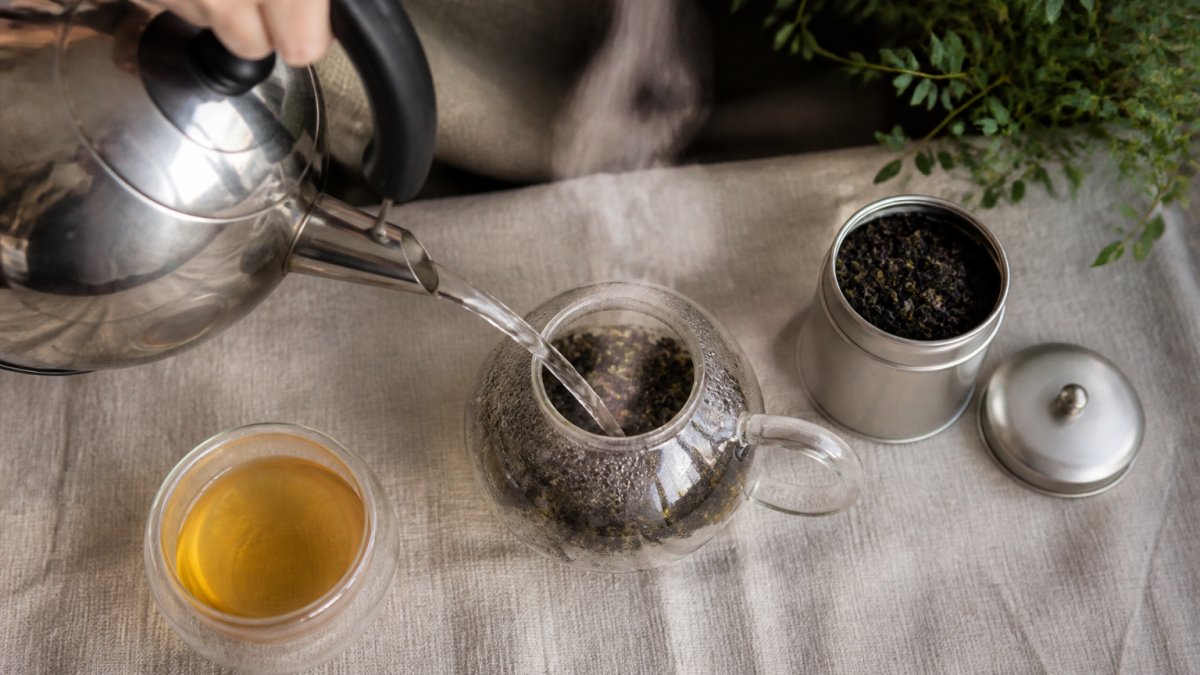
Overhead shot of hands pouring hot water from a kettle into a glass teapot filled with loose leaf tea, steam rising, a small metal caddy and a filled teacup on a linen-covered table beside it
The one rule that matters most: take the leaves out when the time is up. Tea left sitting on the leaves keeps getting stronger and turns bitter.
How to Use a Tea Infuser (and Brew Without One)
A tea infuser holds the leaves so you can lift them out cleanly. Fill it no more than halfway, because the leaves need room to expand. A packed infuser brews unevenly and clogs, and the leaves in the centre stay dry while the outer ones over-steep.
Matching the Infuser to Your Teapot
Most teapots fall into one of three designs, and each needs a slightly different approach:
- Built-in basket infuser. The easiest setup. Add leaves to the basket, pour over them, and lift the basket out when the time is up. Check that the basket sits high enough that the leaves are fully submerged, some sit too close to the spout and leave the top of the leaf pile dry.
- Removable strainer at the spout. Common on traditional ceramic pots. Leaves go loose into the body, and the strainer catches them as you pour. This gives leaves the most room to open, which many tea drinkers prefer for large-leaf teas. The trade-off is that the leaves keep brewing until you empty the pot, so pour the whole pot rather than leaving a second cup sitting on the leaf.
- No infuser at all. Use a separate basket infuser that sits on the pot rim, a floating infuser ball for single cups, or a fine mesh strainer held over the cup at the pour.
Pouring Without a Built-in Infuser
If you are brewing with leaves loose in the pot, a few habits keep the pour clean:
The Island of Tea Gold - Pure Ceylon Black Tea - 100g Loose Leaf Tea →
- Pour steadily, not in a rush. A slow, even pour lets the spout strainer do its job. A fast pour drags leaf fragments through.
- Stop before the last few millilitres. The final tilt of the pot always carries the finest particles. Leave that behind.
- Decant into a second pot or jug if you are not drinking straight away. This stops the brew developing further on the leaf.
- Keep a small secondary strainer for pouring into a serving jug, especially with fine or broken leaf.
Troubleshooting Weak, Bitter or Cloudy Tea
Tea too weak? Add more leaf, not more time. Longer steeping pulls out bitterness before it builds body.
Tea too bitter? Your water was too hot, your steep ran long, or you used too much leaf.
Tea tastes flat? Stale water or old leaves.
A quick check on storage: keep leaves in an airtight tin, away from heat and strong smells.
Multiple Infusions and Re-Steeping Without Losing Flavour
Whole leaf tea can be brewed more than once. Large-leaf teas often give two or three good infusions, and oolong can go further. Each steep pulls out a different part of the leaf, so the second cup often tastes softer and sweeter than the first.
A simple method:
- Add 30 to 60 seconds to each re-steep.
- Keep the water at the same temperature.
- Leave the leaves in the pot between steeps, but do not let them sit for hours.
This is where quality shows. Our Island of Tea Gold is an OP1 large-leaf black tea with a light brew and mild taste, best taken straight. For a stronger morning cup, the English Breakfast tin caddy brews a full-bodied blend from pure Ceylon leaf. Green tea drinkers can try our mellow Sencha, and Earl Grey fans will find the bergamot in our Persian Premium Earl Grey holds up well across two steeps.


For guidance on water quality and safe drinking water, the Australian Drinking Water Guidelines set out what to expect from the tap. If you want a broader grounding in how tea is produced and graded, the FAO overview of tea production is a useful reference. And for anyone building a daily tea habit, the NHS guidance on caffeine offers a plain-language look at how much is sensible.
Brewing loose leaf tea well is a skill, but it is a small one: measure the leaf, watch the temperature, and take the leaves out on time. Do that and every cup improves.
Frequently Asked Questions
How much loose leaf tea should I use per cup?
A good starting point is one teaspoon of loose leaf tea per 200 millilitres of water, or roughly 2 to 3 grams by weight. Large-leaf styles such as OP1 need a slightly heaped spoon because the leaves take up more space, while finely rolled leaves need a level one. If your first pot tastes thin, add half a teaspoon next time; if it tastes harsh, pull back slightly. Adjust to your teapot size rather than guessing per cup.
How long should loose leaf tea steep in a teapot?
Most black teas need 3 to 5 minutes, green teas 2 to 3 minutes, oolong 3 to 4 minutes and white or herbal blends 5 to 7 minutes. Start at the lower end, taste, and add time if you want more strength. Over-steeping is the most common cause of bitterness, so set a timer rather than leaving the leaves in indefinitely. Once the tea reaches the strength you like, pour it out or lift the infuser basket.
What water temperature is best for loose leaf tea?
Black teas brew best at 95 to 100 degrees Celsius, oolong at 85 to 95, green at 70 to 80 and white or herbal blends at 80 to 90. Water that is too hot scalds delicate green and white leaves and turns them bitter, so let the kettle rest for a minute or two after boiling before pouring. A kettle with variable temperature settings makes this far easier to repeat consistently.
Should I use a tea infuser or put leaves directly in the teapot?
Both work. An infuser basket or ball makes removal quick and stops leaves drifting into your cup, which suits smaller teapots and faster brewing. Putting leaves straight into the pot gives them more room to unfurl and release flavour, so it suits large-leaf teas and multiple infusions, but you will need a tea strainer when pouring. Whichever you choose, match the leaf size to the holes so small particles do not escape.









Comments (0)
There are no comments for this article. Be the first one to leave a message!