
Last Updated: September 12, 2026
What You'll Need Before You Start
You don't need laboratory equipment to judge leaf quality. A white plate, a magnifying glass, and a clear glass teapot reveal more about authenticity than any label claim. This guide walks through the same checks our team uses when assessing loose leaf before it reaches a tin.
Gather these five items before you begin:
- A plain white plate or saucer (colour contrast matters)
- A magnifying glass or phone camera with macro mode
- A clear glass cup or small teapot for brewing
- Room-temperature water for the aroma check
- A teaspoon and a clean, dry tea caddy
The assessment takes about fifteen minutes. Work through sight, touch, and smell first, then brew, skipping to the cup means missing the leaf-level signals that separate genuine high-grown Ceylon from repackaged blends.
The Ceylon Tea Lion Logo Meaning and What It Guarantees
The Lion Logo is a certification mark owned by the Sri Lanka Tea Board, and it guarantees that a tea is 100% pure Ceylon, grown, processed, and packed entirely in Sri Lanka (srilankateaboard.lk). It is not a brand logo, and no private company owns it.
That distinction matters: a brand name tells you who sold the tea, while the Lion Logo tells you where it came from and that it met the Tea Board's origin and quality standards. The mark shows a lion holding a sword inside a circular border, with "Ceylon Tea" and the Board's symbols around it.
Check placement. The logo should appear clearly on the front or back of the pack, not as a faint watermark. The Sri Lanka Tea Board's official Lion Logo guidance explains the exact artwork and permitted uses, which is useful when a pack looks almost right but not quite.
How to Identify Authentic Ceylon Tea Leaves by Sight and Touch
Authentic Ceylon tea leaves are wiry, dark, and uneven in length, with a dry, crisp feel and a faint floral or citrus aroma when warm. Spread a teaspoon onto your white plate and look before you smell.
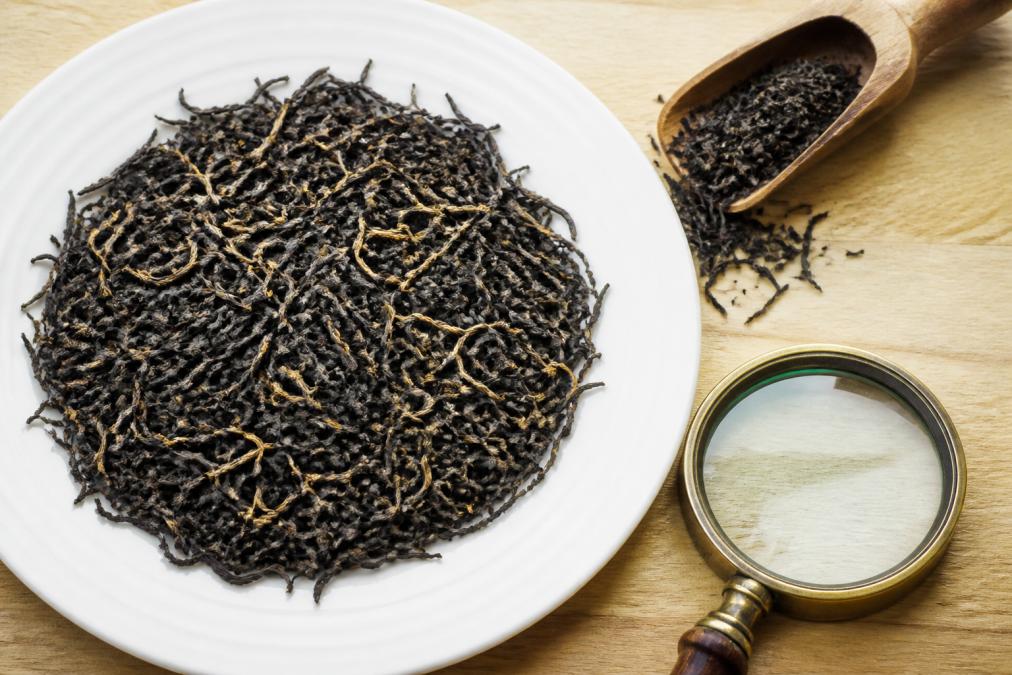
Close-up overhead shot of loose Ceylon tea leaves spread on a white ceramic plate, showing wiry dark strands and golden tips, with a small wooden scoop and magnifying glass beside it on a light timber table
Leaf Shape, Colour, and the Wiry Appearance of High-Grown Tea
High-grown Ceylon from estates above roughly 1,200 metres produces thin, twisted strands that look almost like fine wire, a wiry appearance from slow growth in cool air that is one of the hardest things to fake.
Colour should be consistent but not uniform. Expect dark brown-black strands with scattered golden or silvery tips. A flat, dusty, single-tone brown usually means lower-grown leaf or heavy blending.
Aroma Profile and Leaf Texture Checks
Rub a pinch between your palms and smell. Genuine high-grown Ceylon gives off a bright, slightly citrus or floral note. Flat, papery, or musty aromas point to age or poor storage.
Texture tells you about processing. Well-made leaf feels dry and slightly brittle, snapping rather than bending. Leaf that crumbles into powder at a touch has lost its integrity, and you'll taste that in the cup.
The Ceylon Tea Grading System: Orange Pekoe and Beyond
Orange Pekoe is a leaf-size grade, not a flavour or an orange-flavoured tea. The name is widely believed to trace back to the Dutch House of Orange, and it describes whole, long leaf picked near the bud. On the orthodox grading ladder it sits near the top.
Orthodox processing rolls and twists whole leaves by machine, then sorts them through mesh screens: larger pieces stay on top, smaller pieces fall through. The grade name records which screen the leaf landed on, which is why grade predicts brewing behaviour more reliably than flavour quality.
The main grades you'll see on Ceylon packaging:
Grade |
Leaf Type |
Screen Position |
Typical Character |
|---|---|---|---|
Orange Pekoe (OP) |
Long, whole leaf |
Top screens |
Light, clean, delicate |
Pekoe (P) |
Shorter, coarser leaf |
Upper-mid screens |
Slightly stronger |
Broken Orange Pekoe (BOP) |
Broken leaf |
Mid screens |
Stronger, faster brewing |
Fannings |
Small particles |
Lower screens |
Brisk, quick release |
Dust |
Fine particles |
Bottom |
Harsh, one-dimensional |
Higher-grown estates produce more OP and Pekoe grades because slow growth in cool air favours whole leaf; lower elevations lean toward broken grades, as faster growth fractures more readily during rolling.
Why Tea Dust and Fannings Signal Lower Quality
Dust and fannings are not automatically bad tea, they brew quickly and give strong colour, which suits commercial tea bags. But they release tannins fast, turning bitter if you look away for thirty seconds, while whole leaf holds its flavour through a longer infusion and can often be brewed twice.
For loose leaf buyers, dust is a warning sign. If a premium-priced tin contains mostly fannings, you're paying for packaging rather than leaf.
How to Spot a Misrepresented Grade
Grade claims are easy to print and hard to police, so verify at home. Tip a teaspoon onto your white plate: a genuine OP shows long, unbroken strands with very few small fragments. If the pack says OP but the plate shows long leaf mixed with a visible dust layer, the grade has been overstated or blended down.
A second check is brew timing: whole leaf grades take two to three minutes to open and release colour gradually. If a pack labelled OP gives fully dark liquor inside sixty seconds, the leaf is almost certainly broken or fanned. Photograph the dry and wet leaf side by side, the size change tells you more about grade than any printed claim.
Brewing Characteristics: Liquor Colour, Oxidation, and Infusion
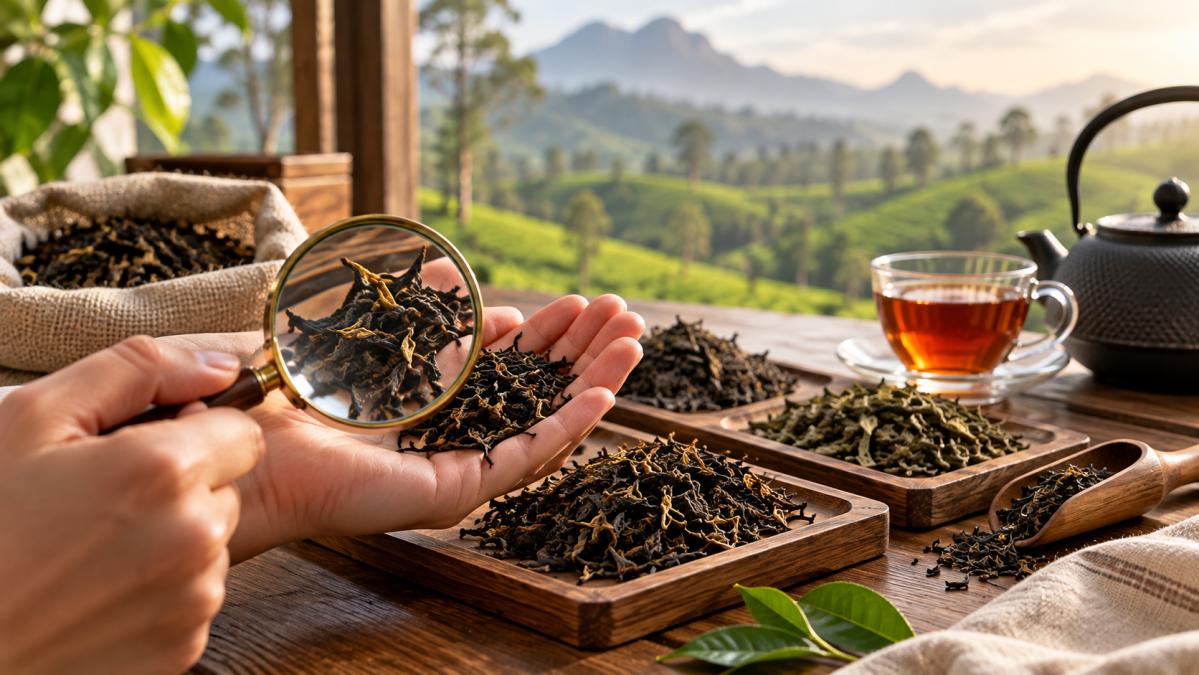
Liquor colour is the clearest single indicator of authenticity and grade. Brew one teaspoon in freshly boiled water for three minutes, then lift the cup to the light.
Authentic high-grown Ceylon typically gives a bright golden or coppery hue with good clarity. Low-grown tea tends darker and heavier. A dull, muddy, or greyish liquor usually signals stale leaf or over-processing.
Oxidation level shapes what you see. Black Ceylon is fully oxidised, giving the deepest colour. Green and white Ceylon are minimally oxidised, so expect pale yellow-green or very light gold.
Watch the leaf as it opens: whole leaf unfurls slowly and evenly across three minutes, while broken grades and fannings release colour within thirty seconds and keep darkening. Fully dark liquor at one minute almost certainly means fannings.
Brightness and clarity matter more than depth. A pale but brilliant golden liquor is a better sign of quality than a dark, opaque one.
The Benefits of Single Origin Ceylon Tea Over Blends
Single origin Ceylon tea comes from one region or estate, so the flavour reflects a specific place rather than a blender's formula. That traceability is the core benefit, and why regional names like Uva and Dimbula appear on quality tins.
Terroir works the same way it does in wine. Uva teas, grown in the eastern highlands, are known for a smooth, well-rounded cup. Dimbula, one of the oldest Ceylon growing regions, produces a fuller-bodied brew with distinct regional character. Sri Lanka's tea export authority on regional Ceylon teas documents how elevation and climate shape each region's output.
Unblended tea also lets you taste the season. Many high-grown estates produce their finest leaf during a short window each year, and single origin packs capture that.
How to Verify a Single Origin Claim
Most guides stop at regional names. The harder question is how a shopper confirms a tin labelled "Uva" actually contains Uva leaf rather than a blend dressed up with a regional name. A few checks narrow the field quickly.
First, look for an estate name, not just a region. Regions cover thousands of hectares and dozens of factories, so a region alone is a weak claim. A named estate or factory is a specific claim that a packer can be held to.
Second, check the elevation. Genuine high-grown Ceylon is typically grown above roughly 1,200 metres, and quality packs state this. A tin claiming a famous high-grown region but giving no elevation is unverified.
Third, look for a batch or lot code that ties the pack to a processing date. Single origin tea is seasonal, so a lot code is the mechanism that lets a packer trace a tin back to a specific plucking. Its absence on a premium-priced product is a genuine concern.
Fourth, compare the liquor across two brews. Single origin high-grown leaf usually holds its character through a second infusion, while blended or lower-grade leaf fades quickly, a second cup tasting like brown-tinted hot water means the pack is unlikely to be what it claims.
Basilur Tea's Leaf of Ceylon range follows this approach. The Uva Regional Black Tea and Dimbula Regional Tea each come from a named region, packed in a foil pouch inside a metal caddy at $24.99 for 100g.


Packaging Red Flags: Reading Labels and Spotting Adulterated Tea
Adulterated tea is leaf stretched with lower-grade material, coloured, or blended across origins while still claiming Ceylon status. Packaging usually gives it away before you brew.
Red flags to check on any tin:
- No Lion Logo, or a logo that looks redrawn or off-centre
- "Ceylon blend" or "Ceylon-style" instead of a stated origin
- No estate, region, or elevation information anywhere
- A batch or lot number missing from the base or lid
- Net weight printed in a way that hides how little leaf you get
- Ingredient list that names other countries alongside Sri Lanka
Batch identification matters more than most buyers realise. A real lot number lets the packer trace the tea back to a specific estate and processing date. Its absence on a premium-priced product is a genuine concern.
If a tin lists a region on the front but a different origin in the fine print on the back, trust the fine print. Front-of-pack claims are marketing; the ingredient panel is the legal description.
Storage and Freshness Testing at Home
Freshness testing is simple: smell the dry leaf, then brew a small cup and check aroma and brightness. Stale tea smells flat and brews dull, regardless of how good it was originally.
Store loose leaf in an airtight container away from light, heat, and strong smells. A metal caddy with a sealed inner pouch, like the ones Basilur Tea uses, does this well, keep it out of the cupboard above the kettle, where steam and warmth speed deterioration.
Run this quick freshness check every few months:
- Dry leaf still smells bright, not papery or musty
- Leaf still snaps when pressed, rather than bending
- Liquor is clear and bright, not cloudy or grey
- Aroma survives the full three-minute infusion
- Second brew still has flavour if you normally re-steep
If two or more boxes fail, the leaf has passed its best. It is still safe to drink, but won't show you what authentic Ceylon should taste like.
A good starting point for benchmarking is the Golden Crescent Pure Ceylon Pekoe, a classic whole-leaf Pekoe at $24.99 for 100g in a metal caddy. Brew it alongside whatever you currently have and compare the liquor side by side. That single test will tell you more than any label.

Golden Crescent - Pure Ceylon "Pekoe" Black Tea - 100g Loose Leaf Tea
Judging Ceylon tea by its leaf takes practice, but the signals are consistent: wiry strands, bright liquor, a clean aroma, and a Lion Logo that actually means something. The gap between a genuine single origin pack and a repackaged blend shows up in the cup every time. Basilur Tea offers a premium selection of Ceylon tea, meticulously crafted from the finest ingredients and blended to perfection for a refreshing and delectable experience in every cup. Our sophisticated and timeless packaging designs make our wide range of artisanal blends the perfect, thoughtful gift for any occasion, ensuring a consistently delightful tea experience. We bring the best of Ceylon directly to you, providing an authentic and sophisticated tea-drinking journey for those who appreciate quality and elegance. Explore the collection and taste the difference a properly identified leaf makes.
Frequently Asked Questions
What does the Ceylon Tea Lion logo signify?
The Lion Logo is a certification mark owned by the Sri Lanka Tea Board. It appears only on packaging that contains 100% pure Ceylon tea grown, harvested, and processed in Sri Lanka. If a box claims Ceylon tea but carries no Lion Logo, the contents may be blended with leaf from other countries or repackaged lower-grade material. Check for the logo alongside a batch identification number on the pack.
How can I tell if tea leaves are high quality just by looking at them?
Authentic Ceylon tea leaves have a wiry, twisted appearance with a mix of dark brown and golden tips. Whole leaves should feel dry but pliable, not brittle or powdery. If you see mostly fine particles, tea dust, or fannings at the bottom of the pack, the grade is lower. A bright, clear aroma with no musty or cardboard notes is another strong indicator of fresh, well-processed leaf.
Is all tea grown in Sri Lanka considered Ceylon tea?
Yes, but only tea grown, plucked, and processed entirely within Sri Lanka qualifies as Ceylon tea. The name is a geographic indicator, similar to Champagne in France. Teas blended with leaf from India, Kenya, or elsewhere cannot legally carry the Lion Logo, even if they are packed in Sri Lanka. For guaranteed origin, look for single origin or unblended on the label alongside the certification mark.
Are whole-leaf teas better than tea bags for authenticity?
Whole-leaf teas generally offer better leaf integrity and a fuller flavour because the essential oils remain intact. Tea bags often contain dust and fannings, which brew quickly but lack complexity. That said, some premium brands use whole leaves in pyramid bags. If you want to verify authenticity by sight and touch, loose leaf gives you the clearest view of grade, texture, and aroma before brewing.








Comments (0)
There are no comments for this article. Be the first one to leave a message!