

What Whole Leaf Tea and Tea Bags Actually Contain
Whole leaf tea is made from intact or largely intact leaves that have been processed and dried. The leaves keep their shape and size, so they have room to unfurl in water.
Basilur's Ceylon Premium Black Tea is sold as 100% pure Ceylon black leaf tea with no additives, in both 100g loose leaf and 25 enveloped tea bags. The ingredient list is the same in both formats. The difference lies in the leaf grade and how much room it has to move.
Loose Leaf Tea vs Tea Bags Taste: What Differs in the Cup
There is a second mechanism at work: circulation. In a teapot or a basket infuser, convection currents move water through and around the leaf, so different compounds are released in sequence. In a sealed paper bag, the leaf is compressed against the paper and water movement is restricted. The bag effectively steeps in a static pocket, which is why even a good-grade bagged tea can taste muddier than the same leaf brewed loose.
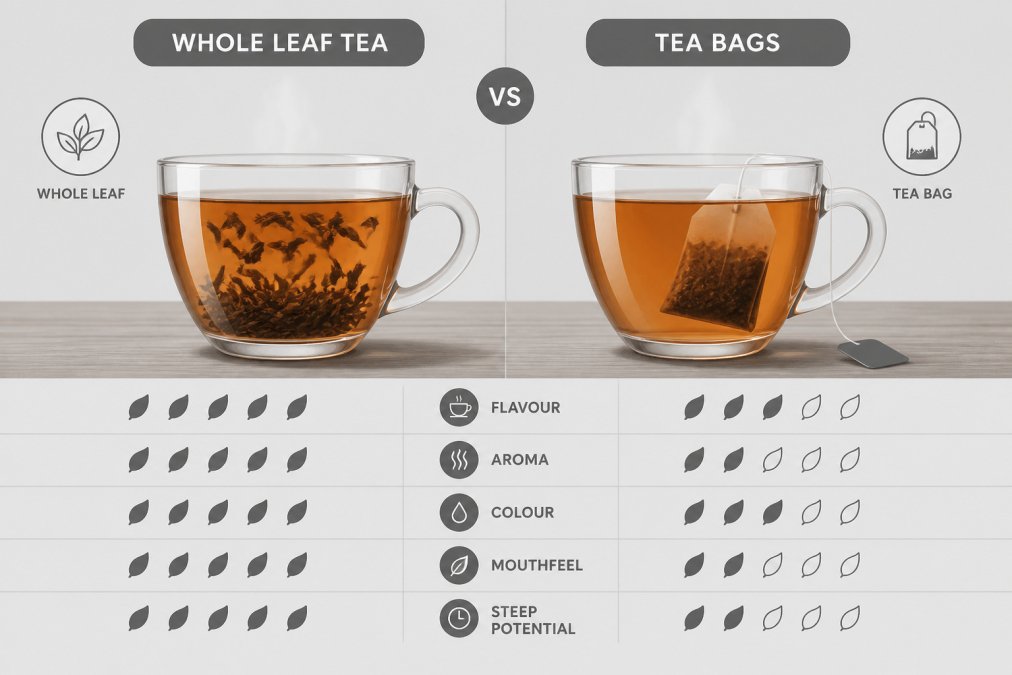
How to Taste the Difference Yourself
A side-by-side comparison is a practical way to judge the difference for yourself. Brew the same blend in loose and bagged form, using the same water and the same three-minute steep. Then work through these four checkpoints:
- Aroma before sipping. Bring the cup to your nose and note how it smells.
- The first sip. Note where the flavour lands on your tongue and which notes come first.
- The mid-palate. Wait a few seconds and notice whether the flavour keeps developing or levels off.
- The finish. Note whether the finish fades cleanly or feels drying.
Taste both cups blind, pour them into identical mugs and have someone else label them. Expectation biases the palate more than most people realise, and a blind test is the only honest way to judge whether the difference is worth it to you.
What Over-Steeping Does to Each Format
Basilur's Ceylon Premium is described as having a fresh, high-grown taste and a bright liquor.
Price, Value and Convenience Compared
Cost per cup is where the two formats separate most clearly. Basilur's Ceylon Premium is available as follows:
Specialty Classics English Breakfast - Tin Caddy - 100g Loose Leaf Black Tea →
Format |
Size |
Price (AUD) |
Best For |
|---|---|---|---|
Ceylon Premium, loose leaf |
100g |
$15.99 |
Daily brewing, multiple infusions |
Ceylon Premium, enveloped bags |
25 bags |
$12.99 |
Quick cups, travel, office use |
English Breakfast, loose leaf |
100g |
$15.99 |
Strong morning cup with milk |
English Breakfast, tin caddy |
100g |
$19.99 |
Gifting and display |
Loose leaf can be re-steeped, so it may give more cups per 100g pack. You can browse premium loose leaf tea online in Australia to compare the range. Convenience is the trade-off: bags need no equipment, but loose leaf needs a strainer or infuser.
Whole Leaf Tea Brewing Guide: Leaf, Water and Time
Most brewing advice stops at 'one teaspoon per cup', which is too vague to be useful once you move beyond a single blend. The ratio that matters is leaf to water by weight, and it shifts with the style of tea. A practical starting framework:
Tea style |
Leaf per 250ml |
Water temperature |
First steep |
|---|---|---|---|
Light black (e.g. high-grown Ceylon) |
2.5-3g |
Just off the boil, around 95°C |
3 minutes |
Full-bodied black (e.g. English Breakfast) |
3g |
Full boil, 100°C |
3-4 minutes |
Flavoured black (e.g. Earl Grey) |
2.5-3g |
Just off the boil |
3 minutes |
If you do not own a scale, use a teaspoon as your baseline and adjust by taste rather than by the clock.
Why Water Temperature and Circulation Matter
Whole leaf needs heat to open the cell walls, but too much heat scalds delicate top notes and drives off the aromatics that give a high-grown Ceylon its brightness. Water just off the boil, when it has stopped rolling but is still steaming, is the sweet spot for lighter blacks. Full-bodied blends and teas taken with milk can handle a full boil because the leaf structure is more robust and the milk softens any edge.
Circulation is the other half of the equation. Pouring water over the leaf agitates it and starts extraction evenly; leaving the leaf sitting in still water produces a flatter cup. If you are brewing in a pot, a gentle stir at the start of the steep does more for the final cup than adding extra time.
Do not judge a tea by its first thirty seconds. Whole leaf releases its flavour in stages, so a cup that tastes thin at one minute may be perfectly balanced at three. Taste at the three-minute mark, then decide whether to go longer, not before.
Re-Steeping: Getting the Second and Third Cup Right
Re-steeping is where whole leaf pulls ahead on value, but the second cup is not simply the first cup repeated. After the first steep, the leaf has opened and the most soluble compounds have already been extracted. The second infusion therefore needs slightly hotter water and a little more time, add roughly thirty seconds to a minute to the first steep.
Stop when the cup tastes thin or woody, that is the leaf telling you it is spent.
A Repeatable Method
- Warm the vessel with hot water, then discard it.
- Measure the leaf by weight where possible, or by teaspoon as a baseline.
- Heat water to the temperature suited to the tea style.
- Pour over the leaf and start a timer.
- Taste at the target time, then decide whether to continue.
- For a second cup, add hot water to the same leaf, extend the time slightly, and taste again.
Brew the same tea this way twice before changing anything. Consistency is what turns brewing from guesswork into a skill, and it is the only way to tell whether a difference you taste comes from the leaf or from the method.
Specialty Classics English Breakfast - Tin Caddy - 100g Loose Leaf Black Tea →
Choosing a Loose Leaf Tea Infuser
A good infuser gives the leaf room to expand. Look for a basket or mesh design large enough that the leaves are not packed tightly, and for a fine enough mesh to keep small particles out of your cup.
How to Store Loose Leaf Tea to Keep It Fresh
Store loose leaf in an airtight container, away from light, heat and strong smells. For the full detail, read how to store premium Ceylon loose tea. The foil zip-lock pouch inside Basilur's tin caddy helps keep the leaf sealed between uses.
Trying Basilur's Whole Leaf Ceylon Teas at Home
If you are new to loose leaf, start with a single-origin Ceylon blend so you can judge the flavour clearly.
Whichever you choose, brew it the same way twice and compare. That single test will tell you more about the difference between whole leaf and tea bags than any description can.
Frequently Asked Questions
Are loose tea leaves better than tea bags?
Loose leaf tea gives the leaf room to expand during steeping. Whether the difference in flavour is worth it depends on your preference and on the specific product you buy. Whether the difference is worth it depends on how much you value flavour, and on the leaf grade of the specific product you buy.
What does whole leaf tea mean?
Whole leaf tea refers to tea made from intact or largely intact leaves rather than the small broken pieces, fannings and dust left over from processing. Whole leaves are typically graded higher and give a more complete flavour when steeped. Basilur's Ceylon Premium and English Breakfast loose leaf blends are examples of whole leaf black tea sold in 100g packs.
Are tea leaves more expensive than tea bags?
Per cup, loose leaf tea can be comparable in price to tea bags, because loose leaf is steeped in larger quantities and can often be re-steeped. At Basilur, a 100g loose leaf pack of Ceylon Premium is AUD 15.99, while 25 enveloped tea bags of the same blend are AUD 12.99. Loose leaf usually costs more upfront but gives you more cups per dollar.
How should you store whole leaf tea?
Store loose leaf tea in an airtight container away from light, heat, moisture and strong odours. A tin or a zip-lock foil pouch works well. Keep it at room temperature rather than in the fridge, where condensation can dull the flavour. Basilur's English Breakfast tin caddy, priced at AUD 19.99, is designed to keep the leaf sealed between uses.










Comments (0)
There are no comments for this article. Be the first one to leave a message!