

Table of Contents
- Earl Grey Cake Recipe: Ingredients for an Elegant Tea-Time Bake
- How to Infuse Tea into Cake: Loose-Leaf, Sachets and Strength
- Mixing the Batter: Creaming, Folding and Citrus Zest
- Earl Grey Cake Baking Time and Oven Temperature
- Troubleshooting: Fixing a Dense, Dry or Sunken Cake
- Substitutions and Dietary Adaptations
- Earl Grey Tea Cake Storage: Make-Ahead, Freezing and Serving
- Conclusion
- Frequently Asked Questions
Last Updated: October 7, 2026
Earl Grey Cake Recipe: Ingredients for an Elegant Tea-Time Bake
An Earl Grey tea cake turns a simple afternoon ritual into something worth slowing down for. At Basilur Tea, we blend pure Ceylon leaves with bergamot oil, and that same bright, citrusy character is exactly what makes this cake work. Below, we'll show you how to build one from scratch, step by step, with the measurements, temperatures and timings that actually matter.

This is a butter-and-egg sponge, not a heavy fruit loaf. It bakes in a single tin, comes together in under an hour, and slices cleanly for afternoon tea. Get the tea infusion right and everything else follows.
What You'll Need
Total time: about 1 hour 15 minutes Difficulty: easy to moderate Makes: one 20 cm round cake, roughly 10 slices
Equipment:
- 20 cm round cake tin, greased and lined
- Electric hand mixer or stand mixer
- Two mixing bowls
- Fine sieve
- Small saucepan
Ingredients:
- 200 g plain flour or cake flour
- 200 g caster sugar
- 200 g unsalted butter, softened
- 4 large eggs, at room temperature
- 2 tsp baking powder
- 60 ml strong brewed Earl Grey tea, cooled
- 2 tbsp milk
- Zest of 1 lemon
- 1 tsp vanilla extract
- Pinch of salt
For the glaze, whisk 100 g icing sugar with 1 tbsp lemon juice and 1 tsp brewed tea.
A common mistake is using cold eggs straight from the fridge. They split the batter and give you a dense crumb. Pull them out 30 minutes before you start.
How to Infuse Tea into Cake: Loose-Leaf, Sachets and Strength
The best way to infuse tea into cake is to brew a concentrated liquid and add it to the batter, rather than steeping leaves directly in the mix. Steeping loose leaves in the batter gives you a gritty texture and an uneven, sometimes bitter flavour.
Here is how the three main methods compare:
| Method | How It Works | Flavour Strength | Best For |
|---|---|---|---|
| Concentrated brew | Steep tea, cool, add liquid to batter | Medium to strong | Most cakes |
| Milk infusion | Warm milk, steep tea, strain | Mild and creamy | Sponges and cream fillings |
| Ground leaves | Grind leaves fine, add to dry mix | Strong and earthy | Loaf cakes and biscuits |
For this recipe, use the concentrated brew. Steep 2 tsp of loose-leaf tea in 100 ml of just-boiled water for 5 minutes, then strain and let it cool. You need 60 ml for the batter.
Why tea turns bitter, and how to stop it
Bitterness in tea comes from tannins, and tannins extract faster as water gets hotter and steeping runs longer. Bergamot oil adds its own aromatic lift, but it will not mask a stewed brew.
A few rules that hold up in practice:
- Use water just off the boil, around 90-95°C for black tea. A rolling boil scorches the leaf and pulls harsh tannins forward.
- Steep for 4 to 5 minutes. Past 6 minutes, the cup turns astringent and the bitterness carries straight into the crumb.
- Strain immediately. Leaving leaves sitting in the liquid keeps extracting even after you have taken it off the heat.
- Cool the brew to room temperature before it meets the butter and eggs. Hot liquid splits the batter.
Infusing into milk, cream and butter
If you want the tea note to sit deeper in the crumb, infuse it into the fat instead of the water.
Milk infusion. Warm 100 ml of full-cream milk to just below a simmer, add 2 tsp of loose-leaf tea, take it off the heat and steep for 10 minutes.
Cream infusion. Heat 150 ml of thickened cream gently, steep 2 tsp of tea for 10 minutes, strain and chill overnight. Whip it for a filling between split layers.
Whole-leaf tea gives a cleaner, brighter cup than dusty broken grades, which is why we pack our Specialty Classics Earl Grey as full leaves.
Mixing the Batter: Creaming, Folding and Citrus Zest
Cream the butter and caster sugar for a full 4 minutes until the mix turns pale and fluffy.
Specialty Classics - Earl Grey Tea - 100g Loose Leaf Tea →
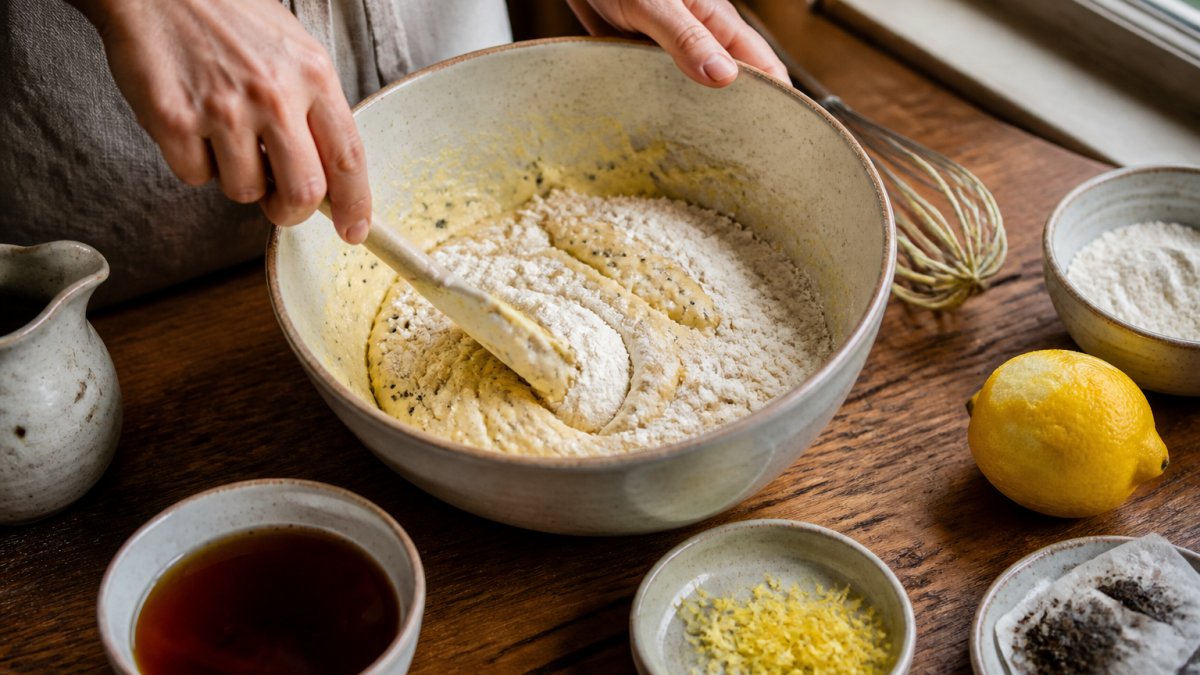
Add the eggs one at a time, beating well after each. If the mix looks like it is curdling, add a spoonful of flour to bring it back.
Now fold in the dry ingredients in three batches, alternating with the tea and milk. Use a large metal spoon and cut down through the middle, then lift and turn.
Stir through the lemon zest and vanilla at the end. Zest lifts the bergamot rather than competing with it.
- Cream butter and sugar 4 minutes
- Beat eggs in one at a time
- Fold flour in three batches
- Add tea and milk between batches
- Finish with zest and vanilla
Earl Grey Cake Baking Time and Oven Temperature
Bake at 180°C (160°C fan-forced) for 35 to 40 minutes. The cake is done when a skewer pushed into the centre comes out clean, with no wet crumbs clinging to it.
Start checking at 32 minutes. Ovens vary, and a sponge goes from perfect to dry in a few minutes.
A few things to watch:
- Position the tin in the middle shelf, never near the top element
- Do not open the door in the first 25 minutes
- Rotate the tin at the 25-minute mark if your oven runs hot on one side
- Cool in the tin for 10 minutes, then turn out onto a rack
Let the cake cool completely before glazing. A warm cake melts the icing straight off.
Troubleshooting: Fixing a Dense, Dry or Sunken Cake
Most Earl Grey cake problems trace back to four causes: under-creaming, over-mixing, cold eggs, or an oven that runs hotter than the dial suggests.

| Problem | Likely Cause | Fix |
|---|---|---|
| Dense, heavy crumb | Under-creamed butter or over-mixed flour | Cream 4 minutes; fold flour gently |
| Dry and crumbly | Baked too long or too much flour | Check at 32 minutes; weigh flour |
| Sunken centre | Oven door opened early or too much liquid | Keep door shut 25 minutes; measure tea |
| Bitter aftertaste | Tea steeped too long or too strong | Steep 5 minutes maximum |
Over-mixing is the one people miss. Once flour meets liquid, gluten starts forming, and every extra stir makes the crumb tougher. Fold until just combined and walk away.
If your cake sinks, it is usually a liquid problem. Two tablespoons of extra tea is enough to collapse the centre.
Substitutions and Dietary Adaptations
Plain flour works fine, but cake flour gives a finer crumb. For a gluten-free version, swap in a good gluten-free blend plus half a teaspoon of xanthan gum, and expect a slightly denser result.
Other swaps that hold up:
- Caster sugar to granulated sugar, blitzed briefly in a blender
- Butter to a neutral vegetable oil, using 160 ml in place of 200 g
- Dairy milk to oat or almond milk
- Lemon zest to orange zest for a softer citrus note
Almond flour alone will not work here. It has no gluten and the cake will not hold its rise without a blend.
Scaling the recipe and choosing a tin
The base recipe makes one 20 cm round cake, roughly 10 slices. If you want a different size, scale by volume and keep the ratios intact.
| Tin | Scale | Bake time at 180°C |
|---|---|---|
| 15 cm round | 0.6× | 30-34 minutes |
| 20 cm round | 1× | 35-40 minutes |
| 23 cm round | 1.3× | 38-44 minutes |
| 20 cm square | 1.25× | 36-42 minutes |
| 12-hole muffin tin | 1× | 20-24 minutes |
A deeper tin needs a longer, slower bake. Drop the temperature by 10°C and add 5 to 8 minutes if the batter sits more than 5 cm deep. Cupcakes are the fastest option and the easiest to portion for a tea table.
Dietary adaptations that actually work
Dairy-free. Replace the butter with 160 ml of a neutral oil or a plant-based block butter, and the milk with oat milk.
Specialty Classics - Earl Grey Tea - 100g Loose Leaf Tea →
Egg-free. Each egg can be replaced with one tablespoon of ground flaxseed mixed with three tablespoons of water, rested for 10 minutes.
Lower sugar. Caster sugar can be cut to 150 g without affecting the rise, though the crust will brown less.
Gluten-free. Use a commercial gluten-free plain flour blend rather than a single flour.
For serving, this cake suits fresh raspberries, a spoon of whipped cream, or a thin layer of buttercream between two split halves.
Earl Grey Tea Cake Storage: Make-Ahead, Freezing and Serving
Store the cake in an airtight container at room temperature for up to 3 days. Add a slice of apple to the container if the crumb starts to dry out.
For longer storage, freeze it. Wrap the cooled, unglazed cake tightly in cling film, then foil, and freeze for up to 2 months. Thaw overnight on the bench before glazing.
Make-ahead tips:
- Brew and cool the tea up to 2 days ahead, stored in the fridge
- Bake the cake a day ahead; the flavour deepens overnight
- Glaze on the day you serve, so it stays glossy
- Freeze individual slices for lunchbox portions
Serve at room temperature, not cold. Cold mutes the bergamot and the cake tastes flat.
Conclusion
A good Earl Grey tea cake lives or dies on two things: a strong, well-strained brew and a light hand with the flour. Nail both and you have a bake that holds its own at any afternoon tea table.
The tea itself does most of the work. Our Specialty Classics Earl Grey loose leaf blends bergamot oil with pure Ceylon leaves for a bright, smooth cup that carries through to the crumb.
If you want a tin for display, our Premium Earl Grey tin caddy holds 100 g of loose leaf in a foil pouch inside a crafted metal tin. For a gift, the Earl Grey foil envelope bulk pack gives you 100 individually wrapped servings.

Bake it once, and you will know exactly how strong you like your brew. Start with our Earl Grey range and taste the difference whole leaves make.
Frequently Asked Questions
Should you use loose-leaf tea or tea bags for Earl Grey cake?
Loose-leaf tea gives the clearest bergamot flavour because the leaves are larger and infuse more evenly. Use roughly 2 teaspoons of loose-leaf tea per 125 millilitres of milk, or 2 to 3 tea sachets for the same volume. Basilur's Specialty Classics Earl Grey loose-leaf tea is a strong choice here, and its foil zip-lock inner bag keeps the leaves fresh between bakes. Whichever you pick, steep the tea directly in warm milk rather than water, then cool it before adding to the batter.
How long does Earl Grey tea cake take to bake?
A standard 20 centimetre round cake or loaf takes 40 to 50 minutes in a 175°C oven. Start checking at 35 minutes with a skewer inserted into the centre; it should come out with a few moist crumbs, not wet batter. If the top browns too quickly, loosely cover it with foil for the remaining time. Smaller tins and muffin-style portions bake faster, so reduce the time by around 10 minutes and test earlier.
How do you keep Earl Grey tea cake moist?
Moisture comes from three things: enough fat, gentle baking and correct storage. Use room-temperature butter and eggs so they emulsify properly, avoid overbaking, and brush the warm cake with a little tea syrup made from strong brewed Earl Grey and caster sugar. Once cooled, wrap the cake tightly in plastic wrap or store it in an airtight container at room temperature. A slice of baking paper pressed against the cut surface also slows drying once the cake is sliced.
Can you make Earl Grey tea cake ahead of time?
Yes, it is one of the easiest cakes to prepare in advance. Bake the cake up to two days before serving, wrap it tightly and keep it at room temperature; the bergamot flavour actually deepens overnight. For longer storage, freeze the unfrosted cake for up to three months, wrapped in two layers of plastic and one of foil. Thaw overnight in the fridge, then bring to room temperature before adding buttercream or a dusting of icing sugar.










Comments (0)
There are no comments for this article. Be the first one to leave a message!