

Ceylon Tea vs English Breakfast: The Core Difference
Ceylon tea is a single-origin black tea grown in Sri Lanka, while English Breakfast is a blend that often includes Ceylon leaf alongside teas from other regions. That distinction shapes everything else: aroma, body, how you brew it, and what you reach for at 7am.

Single-Origin Tea vs a Breakfast Blend
A single-origin tea comes from one country, and usually one growing region within it. Ceylon is the historic name for tea from Sri Lanka, and the island's high-grown gardens produce leaf with a bright, brisk character.
A breakfast blend is assembled. Blenders combine leaves from several origins to hit a consistent flavour, cup after cup, year after year. Ceylon adds brightness and structure, Assam brings malt and body, and Kenyan leaf adds strength.
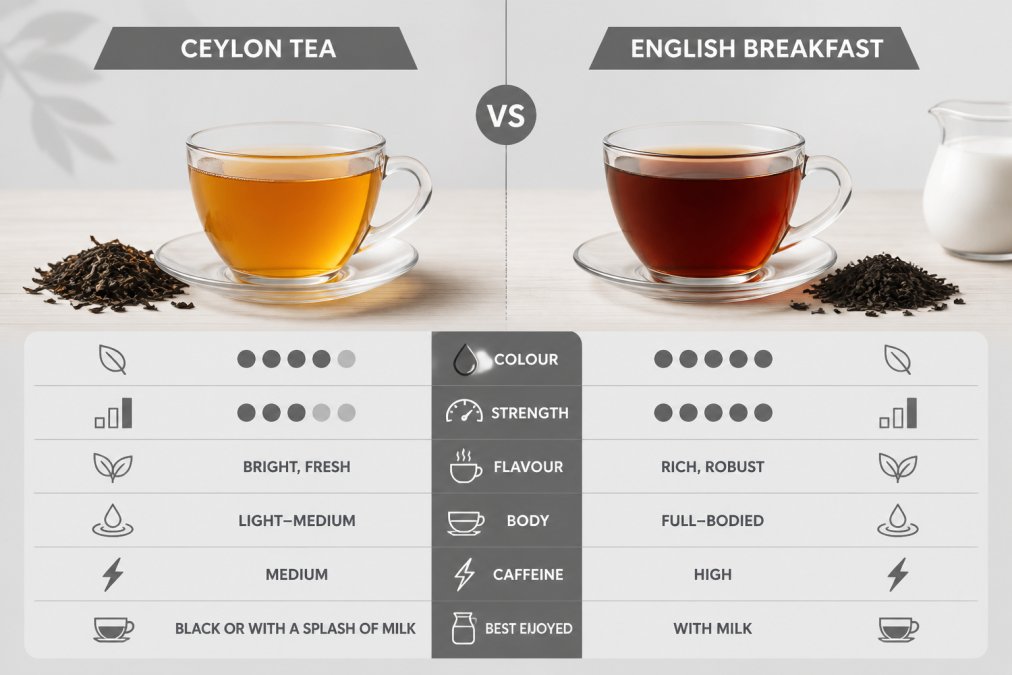
Quick Comparison at a Glance
Feature |
Ceylon Tea |
English Breakfast |
|---|---|---|
Type |
Single-origin black tea |
Blended black tea |
Origin |
Sri Lanka |
Usually Ceylon, Assam, Kenya |
Flavour |
Bright, citrusy, brisk |
Malty, full-bodied, strong |
Best with milk |
Optional |
Traditional |
Caffeine |
Moderate |
Moderate to higher |
What Does Ceylon Tea Taste Like?
Ceylon tea tastes bright and brisk, with citrusy and sometimes floral notes, a medium body, and a clean finish. High-grown leaf tends to be lighter and more aromatic; low-grown leaf is stronger and darker.
Tea grown high on the island's slopes develops slowly, concentrating aroma, while lower gardens grow faster and deliver more tannin and punch.
Grade matters too: a large-leaf OP grade brews lighter and cleaner than a broken grade, even from the same garden. Our Specialty Classics Ceylon Premium Black Tea is 100% pure Ceylon black leaf with no additives, a fair starting point for tasting the origin itself.
English Breakfast Tea Ingredients: What's Actually in the Blend
English Breakfast tea ingredients vary by brand, but the classic recipe combines Ceylon, Assam and Kenyan black teas.

History helps here. According to historical records of the colonial tea trade, the blend we now call English Breakfast emerged in the nineteenth century as tea drinking spread through Britain, and Ceylon became a major supplier as its plantations expanded.
Assam contributes malt and a deep red liquor, Ceylon adds brightness so the cup does not turn heavy, and Kenyan leaf fills out the body.
This is why blend labels matter. A brand that lists its components gives you something to judge.
Ceylon Tea Caffeine: How It Compares to a Breakfast Blend
Ceylon tea caffeine content is moderate, and an English Breakfast blend usually lands in a similar range or slightly higher, but the number on the label matters far less than how you brew it. Both are black teas, so both carry more caffeine than green or white leaf.

Caffeine in brewed black tea typically falls somewhere between roughly 30 and 70 milligrams per 200 millilitre cup, depending on how it is made.
Basilur Premium Specialty Classics English Breakfast - 100 Foil Envelope Bulk →
What Actually Moves the Number
Four variables do most of the work:
- Leaf grade. Broken grades (such as BOP or BOPF) extract faster and more completely than large whole-leaf grades (such as OP or OP1). A broken-leaf breakfast blend will typically release more caffeine in the same steep time than a whole-leaf Ceylon.
- Dose. More leaf means more caffeine. One teaspoon per cup is a starting point, not a rule. A heaped spoon is roughly double a level one.
- Steep time. Caffeine is water-soluble and keeps extracting the longer the leaf stays in contact with hot water. Three minutes and six minutes are not the same drink.
Why Breakfast Blends Often Land Higher
English Breakfast blends frequently include Assam, a robust, malty leaf that extracts quickly and contributes both body and caffeine, and Kenyan leaf, which is similarly strong. Ceylon is usually the brighter, lighter component, adding structure and aroma rather than weight.
That said, a whole-leaf Ceylon brewed with a generous dose and a long steep can easily match a mild breakfast blend. The method, not the origin, is the deciding factor.
If You Are Watching Your Intake
Three adjustments help, in order of impact:
- Use less leaf. Dropping from a heaped teaspoon to a level one is the single biggest lever.
- Shorten the steep. Three minutes instead of five reduces both bitterness and caffeine.
- Drink it earlier. Caffeine has a half-life of roughly five to six hours in most adults, so an afternoon cup can still be active at bedtime.
For a lower-caffeine cup without giving up black tea, a whole-leaf Ceylon brewed short is a sensible choice; for the full, hearty experience, a breakfast blend brewed strong is doing exactly what it was designed to do.
Ceylon Tea Brewing Temperature and Time, and How to Brew English Breakfast
Ceylon tea brewing temperature and time sit at roughly 95°C for three to four minutes. English Breakfast prefers water just off the boil, around 96°C to 100°C, for three to five minutes.
The difference is intent: Ceylon rewards a gentler pour to preserve aroma, while a breakfast blend is built to take heat and come back strong.
Here is how we would brew each:
- Ceylon: one teaspoon of loose leaf per cup, 95°C water, three to four minutes, drink it straight
- English Breakfast: one teaspoon per cup, water just off the boil, three to five minutes, milk and sugar to taste
- Both: pre-warm the cup, use fresh water, and do not squeeze the leaves
Loose leaf gives you control that bags do not. Our English Breakfast tin caddy holds 100g of loose leaf in a foil pouch inside a metal tin, which keeps the leaf fresh between brews.
How to Taste Ceylon Tea and English Breakfast Side by Side
A controlled tasting takes about fifteen minutes and tells you more than any description. The point is not to decide which tea is better, but to isolate what each one actually is, a single origin versus a blend, and taste that difference directly.
Set Up the Comparison Properly
Most side-by-side tastings fail because the two cups are brewed differently. To make the comparison fair, hold everything constant except the tea:
- Same water. Use one batch of fresh water heated to 95°C and use it for both. Do not re-boil.
- Same dose. Weigh or measure the same amount of each tea, one level teaspoon per 200 millilitres is a reasonable starting point.
- Same steep time. Three minutes for both, timed.
What to Look For
Work through four checkpoints, in this order:
- Aroma (before tasting). Smell each dry leaf, then each brewed cup. Ceylon typically shows citrus, floral, or lightly woody notes. A breakfast blend tends to smell maltier and deeper.
- Briskness (first sip). Briskness is the lively, slightly drying sensation on the sides of the tongue. Ceylon is usually the brisker of the two. The blend is rounder.
- Body (mid-palate). Ceylon is generally medium-bodied and clean. A breakfast blend built on Assam and Kenyan leaf is fuller and heavier.
- Finish (after swallowing). Ceylon tends to finish clean and relatively short. A breakfast blend often leaves a longer, maltier aftertaste.
Then add a splash of milk to each and taste again. The Ceylon's bright top notes will flatten noticeably, while the blend will barely change, it was built to carry milk.
Basilur Premium Specialty Classics English Breakfast - 100 Foil Envelope Bulk →
Read the Label Before You Taste
A tasting is only as good as the tea in the cup, and the label tells you what you are actually comparing.
- Ceylon should identify tea grown in Sri Lanka. If the label says "Ceylon" but lists other origins, it is a blend using Ceylon leaf, not a single-origin Ceylon.
- English Breakfast is a style, not an origin. It may be a single-origin tea sold under that name, or a blend of Ceylon, Assam, Kenya, or others. The ingredient list is the only way to know.
- Grade matters. Whole-leaf grades (OP, OP1) brew lighter and cleaner than broken grades (BOP, BOPF). Two teas labelled "Ceylon" can taste very different depending on grade.
Our Island of Tea Gold is an OP1 large-leaf Ceylon that we would brew straight for this kind of tasting, since a big leaf shows the origin clearly without milk getting in the way.
Which Cup Should You Choose?
Choose Ceylon when you want to taste the origin itself, drink your tea without milk, or enjoy something bright with a clean finish.
There is no single winner, they do different jobs.
For a morning cup with toast and eggs, the blend wins. For an afternoon cup where you want to notice what you are drinking, Ceylon wins.
If you are buying a gift and unsure which way to go, our Premium Specialty Classics English Breakfast bulk pack covers the crowd-pleasing option, while a single-origin Ceylon suits the drinker who already knows what they like.
The real challenge is not choosing between these two teas, but finding leaf fresh enough to show what either one can do, since stale tea tastes flat no matter how carefully you brew it.
Frequently Asked Questions
What is the difference between Ceylon tea and English Breakfast tea?
Ceylon tea is a single-origin black tea grown in Sri Lanka, known for its bright liquor, brisk character and citrusy or floral notes. English Breakfast is a blend, traditionally built to take milk and sugar, and it may or may not contain Ceylon leaf. Some breakfast blends are made entirely from Ceylon, which is why the two can overlap. The clearest distinction is origin versus blend: one names where the tea grew, the other names a style of blend.
Is Ceylon tea stronger than English Breakfast?
Strength depends on the blend and how you brew it, not the name on the pack. A breakfast blend is usually assembled for a full-bodied, robust cup that stands up to milk, while a high-grown Ceylon can be brisk yet lighter in the cup. If you want more intensity, use more leaf and a slightly longer steep. The Basilur Ceylon Premium is a pure Ceylon black tea with a fresh high-grown taste and a bright liquor, so judge strength by your own brewing rather than the label.
Does English Breakfast tea contain Ceylon tea?
It can. Traditional breakfast blends often combine teas from several origins, and Ceylon leaf is a common component because its briskness balances maltier leaves. Some blends, including Basilur English Breakfast, are made entirely from pure Ceylon tea. That is why reading the ingredient list matters more than the name: it tells you whether you are drinking a single-origin Ceylon tea or a multi-origin blend.
Which tea has more caffeine, Ceylon or English Breakfast?
Both are black teas, so caffeine levels are similar and depend mainly on leaf quantity, grade, and steeping time rather than origin. A stronger, longer-steeped breakfast blend will usually deliver more caffeine per cup than a lightly brewed Ceylon. If caffeine matters to you, control the dose of dry leaf and the steep time, and treat any single figure as an estimate rather than a fixed number.
Can you drink Ceylon tea with milk?
Yes, though a delicate high-grown Ceylon is often best enjoyed straight so its citrusy and floral notes stay clear. If you prefer milk, choose a fuller-bodied Ceylon or a breakfast blend built for it, such as Basilur English Breakfast, which is blended to go well with milk and sugar. Add milk gradually and taste as you go, since too much can mask the lighter flavours of a single-origin cup.









Comments (0)
There are no comments for this article. Be the first one to leave a message!