

Does Loose Leaf Tea Have More Caffeine? The Short Answer
Does loose leaf tea have more caffeine? Not because of the leaf itself. Gram for gram, loose leaf and tea bag material come from the same plant, Camellia sinensis. What changes is how much of that caffeine actually reaches your cup.
Here at Basilur Tea, we field this question often, and the honest answer surprises people. Loose leaf usually tastes stronger because bigger leaves brew a fuller, richer cup, not because the caffeine count is higher. The real drivers are leaf size, dose, water temperature and steeping time.
Below, we break down what actually moves caffeine into your cup, so you can brew to suit your own tolerance.
Loose Leaf Tea Caffeine vs Tea Bags: What Changes in the Cup
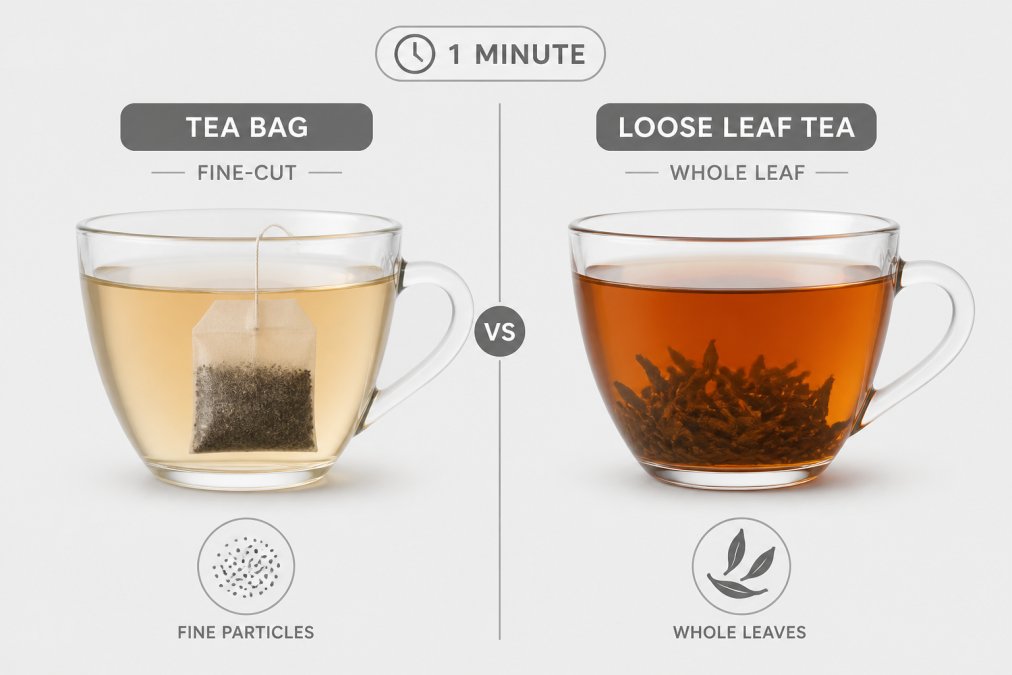
Loose leaf tea caffeine vs tea bags comes down to one thing: how much leaf surface the water can reach. Tea bags often hold broken leaf pieces, called fannings or dust. Those small pieces release their caffeine fast. Whole leaf releases it more slowly.
So a tea bag can actually deliver a quicker caffeine hit than a loose leaf brew of the same weight.
- Tea bags: small particles, fast extraction, quick caffeine release
- Loose leaf: larger pieces, slower extraction, steadier release
- Taste: whole leaf keeps more aromatic oils, so the cup tastes fuller
That fuller taste is why loose leaf feels stronger. It isn't always more caffeine, just more flavour.
Particle Size, Surface Area and Extraction Speed
Surface area is the physics behind all of this. Smaller particles have more exposed surface for the same weight of tea. More surface means water pulls the caffeine out faster.
Think of it like sugar. A sugar cube dissolves slowly. The same sugar, scattered as fine grains, dissolves in seconds. Tea behaves the same way.
This is why a finely cut tea bag can out-caffeine a whole leaf tea in the first minute of brewing. The loose leaf catches up only if you give it more time.
The Extraction Curve: Why the First Minute Matters Most
Caffeine doesn't leave the leaf at a steady rate. It follows what food scientists call a first-order extraction curve: fast at the start, then flattening out as the concentration inside the leaf drops toward the concentration in the water.
A useful way to picture it, based on the general behaviour of water-soluble compounds in hot water:
- First 30 seconds: the outer surfaces of every particle give up caffeine quickly. A tea bag, with its dust-like particles, is already well ahead here.
- One to two minutes: most of the readily accessible caffeine has moved into the water. The gap between bag and loose leaf narrows.
- Three to five minutes: the curve flattens. Longer steeps add body and tannins more than they add caffeine.
This is why a three-minute bagged brew and a three-minute whole-leaf brew often land in a similar range, while a one-minute comparison makes the bag look dramatically stronger.
What This Means for Your Brew
If you want a fast, predictable caffeine hit, a tea bag is genuinely efficient, the small particles do the work for you. If you want control, whole leaf is the better tool, because you decide how far along the extraction curve to travel.
A practical rule: if you're switching from bags to loose leaf and want the same caffeine, don't assume you need more leaf. Start with the same weight, brew for the same time, and adjust from there. Most people find the loose leaf cup tastes stronger at the same caffeine level, which is the flavour difference, not a caffeine difference.
Which Loose Leaf Tea Has the Most Caffeine?
No single leaf wins every time, but the pattern is clear. Stronger, more oxidised teas generally carry more caffeine than lightly processed ones. A brisk black tea usually tops a delicate white tea.

Here's how the main types tend to rank, from higher to lower caffeine:
Specialty Classics - English Breakfast - Black Tea - 100g Loose Leaf →
Tea Type |
Oxidation Level |
Typical Caffeine Feel |
|---|---|---|
Black tea |
Full |
Highest |
Oolong |
Partial |
Medium-high |
Green tea |
Minimal |
Medium |
White tea |
Very low |
Lowest |
Bud-heavy white teas can surprise you, though. Young buds often hold more caffeine than older leaves, so a fine white tea can punch above its weight.
Why Growing Region and Leaf Grade Matter
Where a tea grows shapes its caffeine. High-grown teas from cooler mountain estates tend to develop more caffeine than low-grown teas. The plant produces it as a natural defence, and cooler, higher conditions encourage more.
Leaf grade matters too. Whole leaf grades, such as orange pekoe, brew differently from broken grades. Broken grades extract faster, so they can taste stronger even when the total caffeine is similar.
For a pure Ceylon example, our Specialty Classics Ceylon Premium Black Tea is a high-grown black leaf with a bright, brisk character.
How Brewing Time Affects Tea Caffeine
How brewing time affects tea caffeine is the biggest lever you control. Caffeine is highly soluble in hot water, so it starts leaving the leaf within seconds.
A one-minute steep and a five-minute steep of the same leaf give very different results. Most of the caffeine arrives early, then the curve flattens. So the first minute matters most.
Want less caffeine? Pull the leaves out sooner.
- Short steep (1-2 minutes): lighter caffeine, brighter flavour
- Medium steep (3 minutes): balanced cup
- Long steep (4-5 minutes): full caffeine and full body
A common mistake is blaming the leaf when the real culprit is a ten-minute steep.
How Much Loose Leaf Tea Per Cup (and Why It Changes Everything)
How much loose leaf tea per cup changes your caffeine more than the tea type does. Two grams of leaf and four grams of leaf are not the same drink, even from the same tin.
Doubling the leaf roughly doubles the caffeine, if everything else stays the same. So dose is the simplest way to dial your intake up or down.
Why 'One Teaspoon' Is a Moving Target
The problem with teaspoon advice is that a teaspoon of tea is not a fixed weight. It depends entirely on how you fill it and what's in it.
- Level teaspoon: the spoon is filled and struck flat. For a typical broken-leaf black tea, this is roughly 2 grams.
- Rounded teaspoon: a small dome above the rim. Closer to 2.5 grams.
- Heaped teaspoon: a generous mound. Easily 3 to 4 grams, sometimes more.
The gap between a level and a heaped teaspoon can be close to double the leaf, and therefore close to double the caffeine. Two people following the same recipe can drink very different cups.
Leaf size makes it worse. A teaspoon of fine fannings packs tightly and weighs more than a teaspoon of long, wiry whole leaf, which traps air between the pieces. The same spoon can hold noticeably different amounts depending on the grade.
A Standardised Way to Measure
If you want a predictable cup, weigh your leaf once. A small kitchen scale that reads to 0.1 grams is enough.
Dose |
Approx. leaf weight |
Water |
Typical feel |
|---|---|---|---|
Mild |
1 g per 100 ml |
200 ml |
Light, bright |
Standard |
1.5 g per 100 ml |
200 ml |
Balanced |
Strong |
2 g per 100 ml |
200 ml |
Full-bodied |
Weigh out your usual spoon once, note the number, and you'll never have to guess again. After that, you can judge it by eye with reasonable confidence.
Water-to-Leaf Ratio Matters More Than Leaf Type
Here's the part most guides skip: the ratio of water to leaf changes the concentration of caffeine in your cup, even when the total caffeine extracted stays the same.
Specialty Classics - English Breakfast - Black Tea - 100g Loose Leaf →
Brew the same 3 grams of leaf in 150 ml instead of 300 ml and you've doubled the caffeine concentration per sip, without changing the leaf, the temperature or the time. You've simply given the same caffeine less water to dissolve into.
This is why a small, strong cup can feel more potent than a large, weak one, even though the total caffeine is identical. If you're managing your intake, think in terms of concentration per serve, not just total leaf.
For a lower-caffeine option, our Specialty Classics English Breakfast brews beautifully with a shorter steep, and our loose leaf range gives you full control over every variable.

Myths About Caffeine in Loose Leaf Tea
The biggest myth is that loose leaf is always higher in caffeine. It isn't. Format alone tells you nothing about the caffeine in your cup.
Other myths worth retiring:
- "Green tea has no caffeine." It does. It's usually just lower than black tea.
- "White tea is caffeine-free." Also false. It's typically the lowest, not zero.
- "You can brew the caffeine out in 30 seconds." Most caffeine needs a proper steep to release.
- "Herbal teas contain caffeine." True herbal blends, such as peppermint or chamomile, come from other plants and carry none.
If you want a genuinely caffeine-free cup, choose a herbal blend rather than a lightly brewed true tea.
How to Measure and Manage Caffeine in Your Cup
You can't read caffeine off a label, so manage it through your brewing choices. Small changes add up to a predictable cup.
Try this routine:
- Pick your leaf and weigh it once to learn your dose
- Set a timer and steep for a fixed number of minutes
- Keep water just off the boil for black tea, cooler for green
- Note how you feel, then adjust the dose or time next brew
- Switch to a herbal blend for your evening cup
For a lower-caffeine option, our Specialty Classics English Breakfast brews beautifully with a shorter steep, and our loose leaf range gives you full control over every variable.
Conclusion: Choosing the Right Loose Leaf for Your Caffeine Needs
Caffeine sensitivity varies from person to person, and the "right" cup depends on how your body responds. The good news is that loose leaf puts you in charge. You control the dose, the time and the temperature, so you can tune each cup to suit you.
At Basilur Tea, we blend premium Ceylon teas with the finest ingredients, packed for freshness in timeless designs. Explore our Ceylon Premium and English Breakfast loose leaf selections, then brew your perfect cup. Shop now and taste the difference for yourself.
Frequently Asked Questions
Does loose leaf tea have more caffeine than tea bags?
Not automatically. Gram for gram, the caffeine in loose leaf tea and tea bags is similar because both come from the same plant. What differs is the particle size. Tea bags often use fannings or dust, which have more surface area and release caffeine quickly. Loose leaf tea made from whole leaves releases caffeine more slowly, so a short steep can actually yield less caffeine per cup than a tea bag steeped for the same time.
Which loose leaf tea has the most caffeine?
Ceylon black teas deliver a solid morning lift. White and green teas generally sit lower on the scale.
How does brewing time affect caffeine in loose leaf tea?
Caffeine is highly soluble in hot water, so most of it extracts within the first two to three minutes. A one-minute steep releases roughly half the available caffeine; a five-minute steep releases nearly all of it. If you want a gentler cup, shorten your steeping time rather than reducing the amount of leaf. Longer steeps also pull out more tannins, which can make the cup taste bitter.
Can you reduce caffeine in a cup of loose leaf tea?
Yes. Use a shorter steeping time, lower your water temperature slightly, or try a decaffeinated blend. A common trick is a 30-second rinse: pour hot water over the leaves, discard that water, then brew fresh. This removes some surface caffeine but also washes away flavour compounds. If caffeine is a concern, a naturally caffeine-free herbal blend is the simplest option.









Comments (0)
There are no comments for this article. Be the first one to leave a message!