

Table of Contents
- Whole Leaf vs Tea Bag Quality: The Core Difference
- Tea Leaf Grading Explained: Fannings vs Whole Leaf
- Flavour Profile, Aroma and Extraction Rate
- Loose Leaf Tea Infusion Time and Brewing Control
- Microplastics, Waste and Environmental Impact
- Reusing Tea Tins for Loose Leaf Storage
- Convenience vs Quality: Which Suits You
- Frequently Asked Questions
Last Updated: September 27, 2026
Whole Leaf vs Tea Bag Quality: The Core Difference
Understanding whole leaf vs tea bag quality comes down to leaf size, processing grade, and surface area contact with water. These factors directly affect flavour profile, aroma, and taste. Understanding this distinction changes how you approach tea.
What is loose leaf tea?
Loose leaf tea consists of whole or near-whole tea leaves that remain intact, preserving essential oils and complex flavour compounds. When steeped, whole leaves gradually expand and release tannins at a controlled rate, creating a more nuanced cup.
What are tea bags?
Tea bags contain finely broken tea particles (fannings or tea dust) sealed in paper or synthetic sachets. Smaller particles extract faster but lose complexity and become bitter if over-steeped. Some premium sachets now use whole leaves in biodegradable packaging.
| Format | Leaf Grade | Steeping Time | Flavour Complexity |
|---|---|---|---|
| Whole leaf (loose) | Full leaves, buds | 3-5 minutes | High, layered |
| Tea bag (fannings) | Broken particles, dust | 2-3 minutes | Lower, flatter |
| Premium sachet | Whole leaves | 3-5 minutes | High, layered |
Tea Leaf Grading Explained: Fannings vs Whole Leaf
The tea industry grades leaves by size and appearance. These grades matter because they determine how quickly flavour compounds dissolve and how balanced your cup will taste.
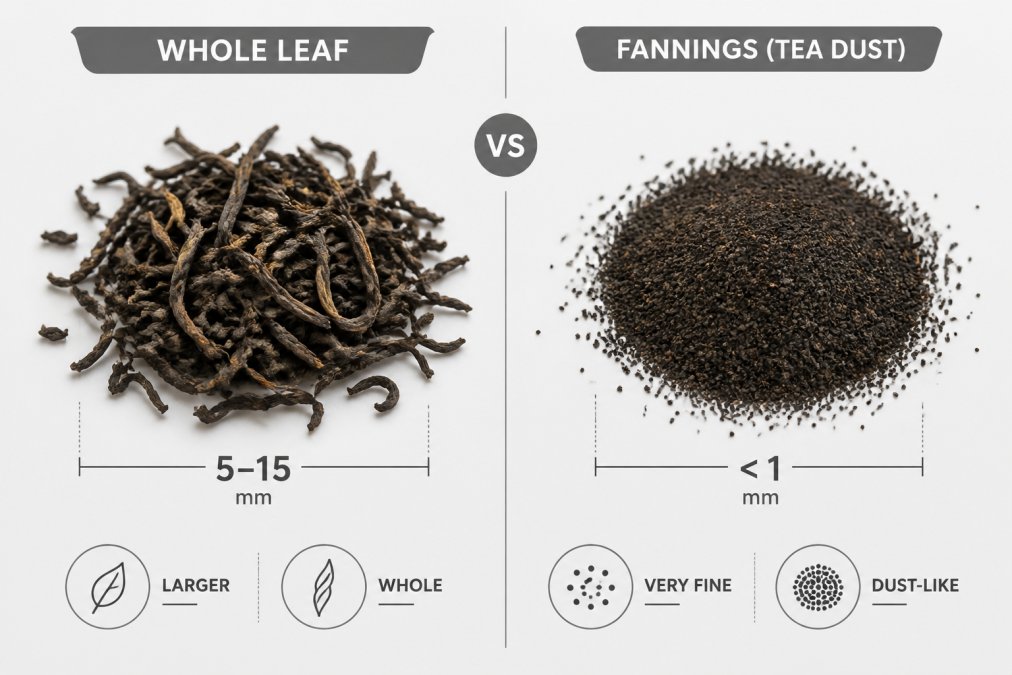
Whole leaf and whole bud grades
Whole leaf teas are graded as Orange Pekoe (OP), Flowery Orange Pekoe (FOP), or Golden Flowery Orange Pekoe (GFOP) based on unopened leaf bud content. More buds mean higher grade and more delicate flavour. When brewed, whole leaves gradually unfurl, releasing tannins slowly for a smoother, more balanced cup with distinct tasting notes, floral, fruity, or earthy depending on origin.
Fannings and tea dust
Fannings are small leaf fragments created during processing; tea dust is the finest particles remaining after sorting. Both have enormous surface area, extracting very quickly. This speed means tea bags brew in 2-3 minutes, but rapid extraction releases tannins all at once, creating harshness if over-steeped. Fannings lack whole leaf complexity because fewer intact cells hold flavour compounds.
Flavour Profile, Aroma and Extraction Rate
Leaf size directly controls how flavour compounds move from leaf into water, revealing whole leaf tea's extraction advantage.
How leaf size affects infusion and tannin release
Whole leaves have smaller surface area relative to volume, so water penetrates slowly and tannins release gradually, creating a balanced cup. Fannings expose interior cells immediately, flooding tannins into water within the first minute and creating harshness if steeped beyond 2-3 minutes.
Water chemistry and leaf surface interaction
Specialty Classics English Breakfast →
Hard water interacts differently with whole leaves versus fannings. Whole leaves' slower diffusion allows minerals to bind gradually to tannins, softening the cup; fannings extract rapidly, amplifying harshness. Slightly alkaline water (pH 7.5-8.5) extracts smoothly from whole leaves, bringing out floral and fruity notes, but over-extracts bitter compounds from fannings. Whole leaf tea performs better across a wider range of water conditions. Use filtered water if your tap is very hard, or let it sit 24 hours before brewing.
Surface area and essential oils
Essential oils that give tea aroma are volatile and dissipate quickly with heat and air. Whole leaves protect these oils until brewing; slow water penetration releases them gradually for full, complex aroma. Fannings expose oils immediately, causing dissipation before steeping even begins, resulting in a flatter cup. Whole leaf Ceylon tea delivers a bright, high-grown aroma that fanning-based tea cannot match.
Brewing vessel and extraction control
A wider infuser or pot allows whole leaves to expand freely and water to flow evenly, ensuring consistent flavour. Narrow vessels concentrate heat and limit circulation, causing uneven extraction. Fannings benefit from smaller vessels with high water-to-leaf ratio to force faster circulation; whole leaves benefit from space and gentle water movement.
Loose Leaf Tea Infusion Time and Brewing Control
Steeping consistency and cup quality
Whole leaf tea offers a wide steeping window (3-5 minutes for black teas, 2-4 minutes for greens and whites), forgiving if you forget your cup. Tea bags demand precision; steep fannings 3 minutes instead of 2 and bitterness jumps noticeably. A proper infuser lets whole leaves expand freely for controlled extraction; cramped spaces slow extraction unevenly.
Microplastics, Waste and Environmental Impact
Tea bag sachets and synthetic materials
Many tea bags are sealed with plastic or plastic-based mesh, leaching microscopic particles into your cup, a health concern that doesn't affect loose leaf tea (pubmed.ncbi.nlm.nih.gov). Single-use tea bags create waste; a daily drinker uses 365 bags yearly. Loose leaf tea can be composted entirely or reused multiple times in the same infuser.
Biodegradable options and waste reduction
Some premium brands use biodegradable sachets, but they remain single-use. Loose leaf tea is lowest-waste because leaves yield multiple infusions. A 100-gram tin of whole leaf tea can be refilled or repurposed indefinitely, eliminating packaging waste.
Reusing Tea Tins for Loose Leaf Storage
Proper storage keeps loose leaf tea fresh for months, and beautiful tins double as décor. But understanding how storage affects whole leaf versus fannings reveals why loose leaf tea holds its quality longer.
Shelf-life and freshness preservation
Whole leaf tea stays fresh longer than fannings because its larger mass loses moisture and oxidises more slowly. The smaller surface area of whole leaves means fewer exposed cell walls where oxygen can attack flavour compounds. Stored in an airtight container away from light, heat, and humidity, whole leaf tea remains vibrant for 6-12 months. Fannings, with their greater surface area, degrade faster, often within 3-6 months, because oxidation happens across a much larger exposed area.
This difference compounds over time. A tin of whole leaf Ceylon black tea opened in January will taste noticeably fresher in June than a tin of fannings opened the same day. The fannings will have developed a stale, flat character; the whole leaf will still show its original brightness and complexity.
Specialty Classics English Breakfast →
Ideal storage conditions and container choice
Tea tins with tight-fitting lids and internal foil liners are ideal. Metal blocks light completely, and the foil prevents air exchange. A well-sealed metal tin creates an oxygen-poor environment that slows oxidation dramatically. Ceramic or glass jars work if you store them in a dark cupboard, but they're not as protective as metal, glass allows light penetration even in dim conditions, and ceramic is porous if not glazed internally.
The most common storage mistake is keeping tea in the original cardboard box or a loose paper bag. Cardboard is porous and allows air circulation; paper bags offer almost no protection. If your tea arrives in packaging like this, transfer it to an airtight metal or glass container immediately.
Temperature stability matters more than absolute temperature.
Humidity and moisture control
Reusing and refilling tins
Signs your tea has degraded
Convenience vs Quality: Which Suits You
The choice between whole leaf and tea bags depends on your priorities and lifestyle.
Cost per cup comparison
When tea bags make sense
Frequently Asked Questions
Why does whole leaf tea taste better than tea bags?
Whole leaf tea contains larger pieces with lower surface area, which means slower, more controlled extraction of tannins and essential oils. This produces a smoother, more balanced flavour profile with greater complexity. Tea bags often contain fannings and tea dust, which have much higher surface area. They release tannins rapidly, creating a harsher, more astringent cup. Whole leaf also retains more aroma compounds during storage, whereas the smaller particles in bags lose volatile oils faster.
What is the difference between tea dust and whole leaf tea?
Tea dust consists of fine particles left over from processing whole leaves. Whole leaf tea comprises intact or nearly intact leaves and buds. Tea dust has vastly more surface area relative to its mass, causing it to steep quickly (often over-extracting in 3-5 minutes), whilst whole leaf requires 4-7 minutes for optimal infusion. Whole leaf expands significantly when steeped, allowing even water circulation. Tea dust remains compact, leading to uneven extraction and muddy flavour. Most commercial tea bags use fannings or dust for speed and cost efficiency.
Is it worth switching from tea bags to loose leaf tea?
The answer depends on your priorities. Whole leaf tea delivers superior flavour complexity, aroma, and consistency cup to cup. You gain control over steeping time and infusion strength. Loose leaf also eliminates microplastic exposure from synthetic tea bag materials. However, loose leaf requires a brewing vessel (infuser, pot, or strainer) and slightly more attention. If you drink tea daily, the cost per cup is often lower with loose leaf despite higher upfront prices. For occasional drinkers or those prioritising pure convenience, quality tea bags remain a reasonable choice.
How does loose leaf tea infusion time differ from tea bags?
Whole leaf tea typically steeps for 4-7 minutes depending on leaf grade and desired strength, because larger leaves release flavour compounds gradually. Tea bags steep much faster, usually 3-5 minutes, because fannings and dust have enormous surface area and extract rapidly. Whole leaf's slower infusion gives you a wider window to adjust steeping without over-extracting bitter tannins. Tea bags are prone to bitterness if steeped beyond 5 minutes. Proper infusion time for whole leaf also depends on water temperature and leaf oxidation level; Ceylon black teas benefit from hotter water (90-95°C) than lighter oolongs.









Comments (0)
There are no comments for this article. Be the first one to leave a message!