
Quick Summary
Adulterated tea is tea that has been mixed with other material, dyed, or passed off as something it is not. Start with the packet: check for a clear origin, a named tea type, a traceable batch number, a printed best-before date and a sealed inner pouch. Vague labels such as "tea blend" leave you guessing.
- Look for a clearly stated origin, such as Ceylon or Sri Lanka.
- Check that the ingredient list names only tea, plus any listed flavouring.
- Be wary of a best-before date that has been overprinted, scratched or stickered over.
- Stop using any tea that smells strange, has an unusual colour or shows contamination.
- Home tests can flag a suspicious pack but cannot prove adulteration.
Table of Contents
- Why Packaging Is the First Place to Check for Adulterated Tea
- How to Read Tea Packaging Labels
- Inspecting Sealed Tea Packaging Before You Buy
- Tea Adulteration Signs in Dry Leaves and Powder
- How to Check Tea Purity at Home
- What the Limits of Home Tests Mean for Your Purchase
- What to Do About Suspected Adulterated Tea
- Choosing Packaged Tea You Can Trust at Home
- Frequently Asked Questions
How to Identify Adulterated Tea in Packaging
Last Updated: November 16, 2026
Why Packaging Is the First Place to Check for Adulterated Tea
Adulterated tea is tea that has been mixed with other material, dyed, or passed off as something it is not.
Most adulteration problems start with a vague label. A packet that says only "tea blend" with no origin, no harvest details and no batch information leaves the buyer guessing. A clear, specific label gives you something to check.
Here is what to look for before you buy:
- A clearly stated origin, such as Ceylon or Sri Lanka
- A named tea type, such as black, green, white or oolong
- A batch or lot number you can trace
- A printed best-before date
- A sealed inner pouch or tin, not a loose or open bag
Packaging alone cannot prove that tea is pure. It can, however, show you whether the seller is being open about what is inside. That openness is a useful first filter.
How to Read Tea Packaging Labels
Labels carry more information than most people realise, and for a packaged product the label is often the only evidence you have before you open the pack.
Pay attention to the wording. "Made with Ceylon tea" can mean the tea is only a small part of the blend. "100% Ceylon tea" is a stronger claim.
If you want to confirm an origin claim, a guide to identifying authentic Ceylon tea leaves can help you understand what genuine origin claims look like on a label.
Check these label details:
- Ingredient list: Should name only tea, plus any flavouring you can see listed
- Origin statement: Should name the country and, ideally, the growing region
- Tea grade or style: Should match what the leaves look like when you open the pack
- Net weight: Should be printed in grams, so you can compare prices fairly
- Manufacturer or packer name and address: A business that stands behind its product will name itself and give a contact address
- Lot or batch code: A traceable code lets the seller investigate a specific production run
- Date marking: A best-before or use-by date that is printed, legible and not applied as a sticker over another date
A few label patterns deserve a closer look.
Labels are only as honest as the company behind them. Choose brands that are specific, consistent and easy to contact with questions.
Inspecting Sealed Tea Packaging Before You Buy
Sealed packaging protects tea from moisture, light and handling. Before you buy, check that the seal is intact and that the packet has not been opened and resealed.
If you are buying in a shop, ask to see the best-before date and the batch code.
A quick inspection checklist:
- The seal or lid is intact and tight
- There are no tears, dents or damp patches
- The best-before date is clearly printed and not expired
- The batch or lot number is visible
- The origin and tea type are stated on the pack
If a packet fails any of these checks, it is reasonable to choose another. You are paying for tea, and the packaging is part of the quality signal.
Use this quick checklist to inspect a sealed pack before you buy it.
Check |
What to look for |
Why it matters |
|---|---|---|
Seal or lid |
Intact and tight |
Shows the pack has not been opened and resealed |
Damage |
No tears, dents or damp patches |
Protects tea from moisture and handling |
Best-before date |
Clearly printed and not expired |
Confirms freshness |
Batch or lot number |
Visible on the pack |
Lets the seller trace the production run |
Origin and tea type |
Stated on the pack |
Gives you something to verify |
Tea Adulteration Signs in Dry Leaves and Powder
Once you open a sealed pack, the dry leaves tell you a great deal. Good whole-leaf black tea usually shows a range of leaf sizes, with a clear twist or curl and a dark, even colour. Green and white teas look more delicate, while oolong falls between the two.
Warning signs in dry tea include:
- Unusually bright, artificial-looking colour
- A large amount of fine powder or dust at the bottom of the pack
- Leaves that look uniform in an unnatural way, as if they were coloured
- A strong or chemical smell that does not match the tea type
- Small specks or pieces that look like something other than leaf
Some dust and fine particles are normal in any loose tea. The question is how much, and whether the leaves look natural. A small amount of dust is common in cheaper blends. A pack that is mostly powder is a different matter.
How to Check Tea Purity at Home
Home checks can give you a first impression. They cannot confirm purity on their own, but they help you decide whether a pack deserves a closer look. The simplest methods are visual, water-based and paper-based.
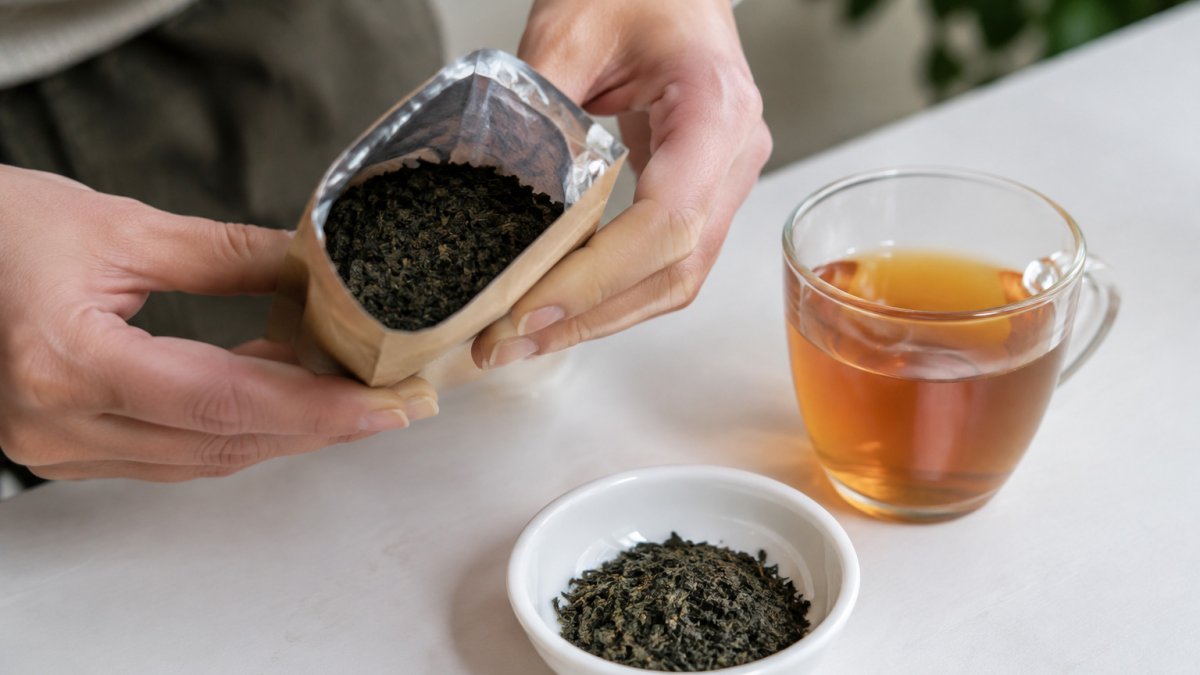
!Hands holding an open tea packet over a white table, with a clear glass of tea and a small dish of dry leaves nearby in soft natural light
Start with the simplest check: look at the dry leaves in good light and compare them with what you expect for that tea type.
Visual Inspection and Water Test
For the water test, place a small spoonful of tea in a clear glass of warm water and watch what happens for a few minutes.
- Natural tea usually releases colour slowly and evenly
- Artificial dye can release colour quickly and look unusually bright
- Cloudiness, or a surface film that does not look like normal tea, is worth noting
- Leaves that sink and colour the water evenly are a reasonable sign
Observe the liquor colour too. Black tea should brew to a deep amber or reddish brown. Green tea should be pale and golden or green. A bright red or yellow tint is a reason for caution.
Paper Rub and Magnet Tests
The paper rub test is a simple check for synthetic colour. Wet a white paper towel, rub a few leaves on it, and let it dry. Natural tea stains can look dull and brownish. Synthetic dye may leave a brighter streak or transfer colour more strongly.
For the magnet test, spread a small sample of dry leaves on white paper and pass a magnet underneath. If tiny metal filings cling to the magnet, the sample may contain iron. This test is useful, but it should not be relied on alone.
What the Limits of Home Tests Mean for Your Purchase
Home tests are screening tools. They can flag a suspicious pack, but they cannot measure contaminants or confirm exactly what is in the tea. A tea that passes every home test may still contain material you cannot see. A tea that fails one test may simply have an unusual but harmless leaf style.
Keep these limits in mind:
- Results depend on the tea type, so a green tea and a black tea will not behave the same
- Water and paper tests can be influenced by how much tea you use
- Only laboratory analysis can confirm contaminants or dye content
- A single test is not enough. Look at the pack, the leaves and the brew together
Think of home tests as a way to decide whether to buy, not as proof. For a pack you have real doubts about, the sensible step is to stop using it and speak to the seller.
What to Do About Suspected Adulterated Tea
If a pack looks wrong, stop using it. Do not drink tea that smells strange, has an unusual colour or shows signs of contamination.
Work through these steps in order:
- Set the product aside. Seal it in its original packaging, or in a clean airtight container if the pack is damaged, and keep it away from other food. Do not throw it out before you have recorded the details.
- Record what you saw. Note the product name, brand, batch or lot code, best-before date, where and when you bought it, and what you observed, colour, smell, powder level, any test result. Photograph the pack, the label and the leaves.
- Contact the seller or manufacturer. Describe what you saw and give them the batch details. A reputable company will want to know and should explain how it checks its supply. Keep a record of the response.
- Report a food safety concern if needed. If you believe a food product is unsafe, you can report it. Reporting helps protect other buyers and gives regulators a chance to act.
- Consider laboratory confirmation if the stakes are high. Laboratory analysis is the only reliable way to establish what a sample contains, so keep the original packaging where possible and ask the seller or regulator whether testing is warranted.
Watch out: home tests can flag a suspicious pack, but they cannot prove adulteration.
A common pattern is that a genuine quality problem shows up across a whole batch rather than a single pack, which is why the batch code matters more than the individual packet when you report.
Choosing Packaged Tea You Can Trust at Home
Once you have a tea you trust, storage matters too. Keep it in a cool, dry, dark place, in its original sealed container or an airtight tin. Heat, moisture and light can dull flavour and affect quality over time, even when the tea is pure.
When you choose a brand, look for consistency. Clear labelling, traceable batches, specific origin statements and sealed packaging all point to a company that takes quality seriously.
Once you have chosen a pack, store it well so the flavour lasts. You can find practical advice in a guide to storing premium Ceylon loose tea for freshness. When you are ready to buy, you can explore Basilur Tea's Ceylon range online to find a blend that suits you.
Frequently Asked Questions
How can you tell if packaged tea is adulterated?
Start with the packaging itself. Check that the seal is intact, the batch number and best-before date are clearly printed, and the label names the origin, grade and packer. Then look at the dry leaves: uneven colour, unusually bright or dusty leaves, and a large share of fine powder can all be signs of poor quality or mixing. A suspicious appearance is a reason to look closer, not proof of adulteration on its own, so compare the batch against what you expect from that tea type.
Do home tests reliably detect adulterated tea?
Home checks such as visual inspection, the water colour test, the paper rub test and the magnet test are useful for screening. They can flag leaves that look or behave unusually and prompt further scrutiny. They cannot confirm the presence or absence of specific contaminants or dyes, and a clean result does not guarantee purity. Treat them as a first step and rely on the brand's transparency and sourcing information for more assurance.
What should you check on a tea label to verify its origin?
Look for a clearly stated country or region of origin, the estate or garden name where available, the tea type and grade, and the packer's name and address. Vague wording such as 'blended from various origins' with no traceable detail is a reason to ask questions. Batch numbers and a best-before date help you trace a specific pack if you later need to raise a concern with the seller or brand.
What should you do if you suspect packaged tea is adulterated?
Keep the packet, its seal and the batch details, and photograph the leaves and the label. Contact the retailer first, then the brand's customer service, and describe exactly what you observed. If you believe the product is unsafe or misrepresented, you can report it to the relevant Australian food regulator in your state or territory, which can assess the product through proper laboratory testing. Do not rely on home tests alone to confirm a serious concern.










Comments (0)
There are no comments for this article. Be the first one to leave a message!