

Last Updated: November 4, 2026
Quick Summary
Orange Pekoe is a leaf grade describing leaf size and style, not a flavour, so it contains no orange and tastes of malt and tannins. Tea grades sort leaf appearance and predict brewing behaviour rather than ranking quality, which is why a well-made OP can outperform a tired TGFOP.
- Orange Pekoe letters describe leaf size, tips and handling, not a quality score.
- Larger whole leaf grades infuse slowly, while broken grades and fannings extract fast.
- Grade codes vary by country and estate, so read grade alongside origin.
- Steep whole leaf OP three to four minutes and broken grades only one to two.
- The most common error is over-steeping a broken grade as if it were whole leaf.
Table of Contents
- What Orange Pekoe Actually Means
- Black Tea Grades Explained: What the Letters Tell You
- Ceylon Tea Grades and the Leaf Sizes Behind Them
- How Leaf Size and Processing Change the Cup
- Whole Leaf, Broken Leaf, Fannings and Dust
- How to Brew Orange Pekoe Tea Without Losing Its Character
- Reading the Label Before You Choose Your Tin
- Frequently Asked Questions
What Orange Pekoe Actually Means
Orange Pekoe is a leaf grade, not a flavour. The name describes the size and style of the leaf picked from the tea plant, Camellia sinensis, and tells you nothing about citrus, orange peel or orange oil. A tin marked "Orange Pekoe" holds plain black tea, graded by leaf appearance, and the cup tastes of malt, tannins and aroma rather than fruit.
So why the confusion? Because "orange" is the one word in the phrase that sounds like an ingredient, and the rest of the phrase sounds like a variety. Neither is true. Understanding tea grades starts with unlearning that assumption.
The Dutch Name That Never Was a Flavour
A widely repeated explanation traces the term to the Dutch East India Company and its influence on the early European tea trade. Under this account, "orange" honoured the House of Orange, and "pekoe" came from a Chinese term for the downy white tips on young buds. We cannot verify the court connection from primary records, so treat it as trade lore rather than settled fact.
What is certain is the outcome: a marketing label from centuries ago hardened into a grading term that still confuses shoppers today. The word survived, the meaning shifted, and the citrus association was never there to begin with.
Black Tea Grades Explained: What the Letters Tell You
Black tea grades are a sorting language, not a quality score. The letters describe leaf size, the presence of tips and buds, and how the leaf was handled during tea processing. A larger leaf grade is not automatically a better cup, and a small grade is not automatically worse. What the letters give you is a prediction about strength, speed of infusion and aroma.
The system works because leaf size is measurable. After oxidation and drying, the leaf is sorted through a series of mesh screens, and each screen catches a different size band. The largest pieces stay on top, the smallest fall through, and the sorter names each band with a letter code.
OP, FOP, TGFOP and the Rest of the Alphabet
Here is how the main black tea grades compare:
| Grade | What the letters mean | Leaf character | What to expect in the cup |
|---|---|---|---|
| OP | Orange Pekoe | Long, wiry whole leaf, no tips | Clean, balanced, gentle |
| OPA | Orange Pekoe A | Longer, larger whole leaf | Lighter, slower to infuse |
| FOP | Flowery Orange Pekoe | Whole leaf with some tips | More aroma, slightly fuller |
| GFOP | Golden Flowery Orange Pekoe | Noticeable golden tips | Sweeter, rounder |
| TGFOP | Tippy Golden Flowery Orange Pekoe | High proportion of tips | Fragrant, complex, lighter body |
| FTGFOP | Finest Tippy Golden Flowery Orange Pekoe | Very high tip content, carefully handled | Delicate, aromatic, prized by buyers |
| BOP | Broken Orange Pekoe | Cut leaf | Stronger, faster infusion |
| BOPF | Broken Orange Pekoe Fannings | Fine fragments | Brisk, quick, tannic if over-steeped |
| D | Dust | Smallest particles | Very strong, turns bitter fast |
A common mistake is assuming TGFOP always beats OP. It does not. A well-made OP from a good estate can outdrink a tired TGFOP, because grade sorts leaf appearance while quality depends on the garden, the season and the manufacturing. The letters tell you what the leaf looks like and how it will behave in water; they do not tell you how carefully it was grown or processed.
Why the Same Letters Mean Different Things in Different Origins
Grade codes are not administered by a single global body. Each producing country and often each estate applies the letter system with local conventions, which is why a Ceylon OP and an Assam OP can look and taste quite different despite sharing a code. The practical takeaway is to read the grade alongside the origin and the leaf form, never in isolation.
Does a Higher Grade Mean a Better Cup?
No. Grade predicts behaviour, not enjoyment. A tippy TGFOP suits a drinker who wants fragrance and a lighter body; a robust BOP suits someone who wants a strong morning cup with milk. The grade that is "best" depends on how you brew and what you want from the cup, which is why the letter code should be read as a tool for choosing, not a badge of quality.
Ceylon Tea Grades and the Leaf Sizes Behind Them
Ceylon tea grades follow the same letter system, with one addition worth knowing: an "A" suffix, as in OPA, signals a larger leaf still. Ceylon's grading also separates leaf grades from broken grades and from fannings, so the same estate can produce several distinct lots from one day's picking.
Leaf size drives everything downstream. A larger leaf exposes less surface to water, so it infuses slowly and rewards patience. A broken leaf gives up its colour and tannins quickly, which suits a strong morning cup but punishes anyone who walks away from the pot. If you want to recognise authentic Ceylon leaf by eye, our guide to identifying authentic Ceylon tea leaves walks through the visual cues.
How Leaf Size and Processing Change the Cup
Processing decides how much of the leaf's potential reaches your cup. Oxidation, the controlled browning that turns green leaf into black tea, builds the coppery colour and the tannins that give structure. Rolling and drying then set the leaf's final shape, and that shape governs how fast water can do its work.
Smaller pieces extract faster and harder. Larger pieces extract slowly and leave more room for aroma to develop. Neither is superior; they are different tools. The practical consequence is that you cannot brew every grade the same way and expect the same result.
Golden Crescent - Pure Ceylon "Pekoe" Black Tea - 100g Loose Leaf Tea →
Whole Leaf, Broken Leaf, Fannings and Dust
Whole leaf, broken leaf, fannings and dust are the four broad size bands in tea classification, ranked from largest to smallest. Whole leaf brews clear and aromatic. Broken leaf brews strong and brisk. Fannings and dust, the fine fragments left after sorting, brew fast and turn bitter quickly, which is why they dominate cheap tea bags. For a fuller comparison of loose leaf against bagged tea, see our breakdown of whole leaf tea versus tea bags.
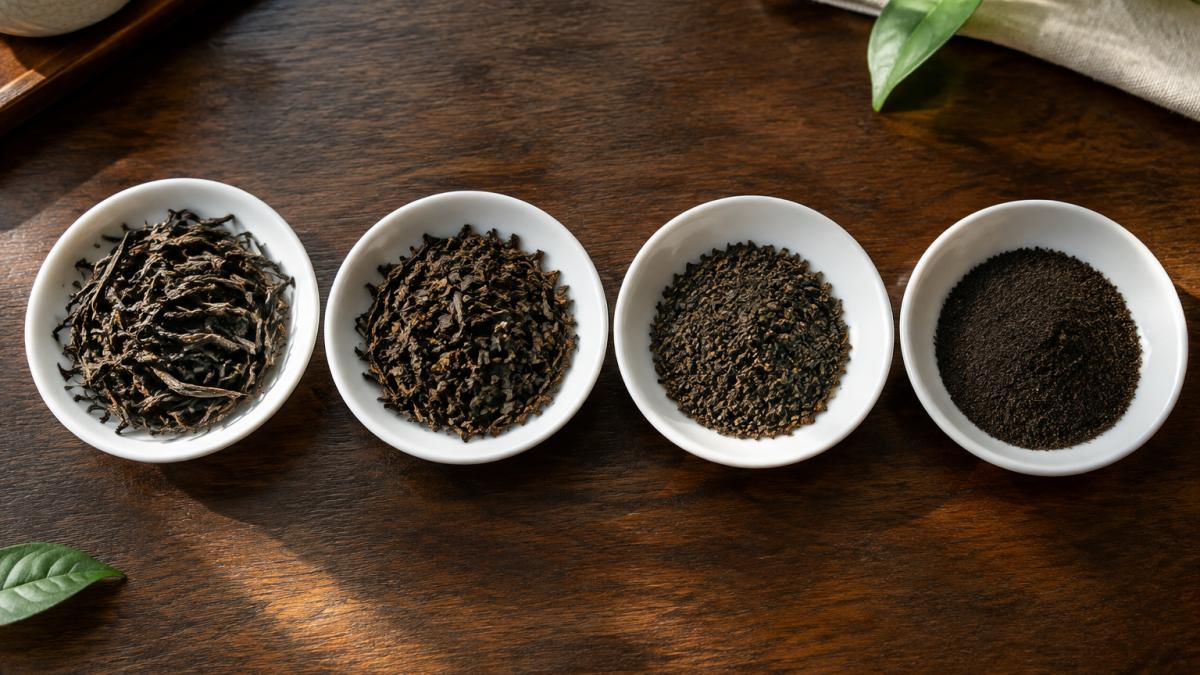
This is where premium claims get tested. A brand can print "Ceylon" on a beautiful tin and still fill the bag with dust. If leaf grade matters to you, buy loose leaf where you can see the leaf, or ask plainly what grade is inside.
How to Brew Orange Pekoe Tea Without Losing Its Character
Brew Orange Pekoe with water just off the boil and a steeping time that respects the leaf size. Our guide to brewing whole leaf tea for a richer cup covers the variables in detail.
The reason grade changes the brew is surface area.
Brewing adjustments by grade:
- Whole leaf OP or OPA: use freshly boiled water and steep for around three to four minutes, tasting as you go, because the leaf releases slowly. Expect a lighter liquor that rewards a second infusion.
- FOP and TGFOP: drop the water temperature slightly below boiling and shorten the steep to around two to three minutes so the tips' fragrance is not flattened. These leaves are the most sensitive to over-steeping.
- Broken grades (BOP, BOPF): steep briefly, around one to two minutes, and taste early; these leaves give up their strength fast and turn tannic quickly.
- Fannings and dust: treat them as a quick brew only, around one minute, and expect tannins to dominate if you linger.
A useful rule of thumb is to match the steep to the leaf, not to the label. If a cup tastes thin, the leaf was probably too large for the time given; if it tastes drying and bitter, the leaf was probably too small for the time given.
Watch out: the most common error is over-steeping a broken grade while assuming it behaves like whole leaf. The result is a harsh, drying cup that tastes like a fault when it is really a timing problem.
Water, Ratio and Re-steeping
Use soft-to-moderately-hard water; very hard water mutes aroma and can make the liquor look dull. A common starting ratio is roughly one teaspoon of leaf per cup, adjusted upward for large whole-leaf grades because they take up more space for the same weight. Whole-leaf OP and OPA grades often reward a second infusion at a slightly longer steep, while broken grades and fannings are generally a single-brew proposition. If you want to compare grades side by side, brew them at the same ratio and taste at one-minute intervals to see how quickly each one peaks.
Reading the Label Before You Choose Your Tin
Read the grade, the origin and the leaf form before you read the packaging copy. A label that names a grade and a region tells you far more than one that leads with adjectives. Look for the letter code, check whether the leaf is loose or bagged, and note whether the tin names a growing region rather than a country alone.
For a concrete example of a regional Ceylon loose leaf, our Ruhunu regional Ceylon black tea shows how a named growing area reads on a label. And if you want to taste what a true Pekoe grade actually delivers, our Golden Crescent pure Ceylon Pekoe loose leaf is a straightforward place to start: a long-leaf black tea in a metal caddy, graded honestly and priced at $26.99 for 100g.


Frequently Asked Questions
Does Orange Pekoe tea taste like orange?
No. Orange Pekoe is a leaf grade, not a flavour, so a cup labelled Orange Pekoe tastes of black tea: malty, brisk and lightly astringent depending on where it was grown and how it was processed. Any citrus note you detect comes from the tea itself or from added ingredients, not from the words on the tin. If you want orange flavour, look for a blend that lists orange peel or oil in the ingredients.
Is Orange Pekoe a type of tea or a tea grade?
It is a grade. Orange Pekoe describes the size and style of the leaf, most often on black tea from Camellia sinensis, and it says nothing about flavourings. The same garden can produce several grades from one day's picking, sorted by leaf size after processing. That is why two tins both marked Orange Pekoe can taste noticeably different: the grade tells you what the leaf looks like, not which estate it came from.
What is the difference between Orange Pekoe and Pekoe?
The difference is leaf style and picking standard. Pekoe generally refers to shorter, more tightly rolled leaves picked without the tip, while Orange Pekoe usually indicates a longer, wiry leaf taken from the young shoot. In the cup, Pekoe tends to infuse a little faster and read slightly stronger, while Orange Pekoe gives a lighter, more aromatic liquor. Neither term refers to flavour or to a colour.
How should you brew Orange Pekoe tea?
Use freshly boiled water cooled to roughly 90 to 95 degrees Celsius, about one teaspoon of leaf per 200 millilitres, and steep for three to four minutes. Whole leaf grades like Orange Pekoe need the longer end of that range to open up, while broken grades release faster, so taste at three minutes before deciding. Serve without milk first to judge the leaf, then add milk if you prefer a stronger cup.
The gap between a good cup and a disappointing one usually comes down to knowing what the letters mean and brewing to match. Basilur Tea brings Ceylon leaf to your shelf in tins built to keep it fresh, with grades you can read and blends made to be shared. Explore the range, start with a Pekoe you can actually see, and taste the difference a grade makes. Shop now with Basilur Tea and brew a cup that earns its label.










Comments (0)
There are no comments for this article. Be the first one to leave a message!